
CBD and Pain: Research, Safety, and What Adults Should Know

CBD and Pain: Research, Safety, and What Adults Should Know

CBD Research and Safety Guide

CBD and Pain: Research, Safety, and What Adults Should Know

Many adults researching CBD are also looking for pain information. This consumer guide explains what CBD research can and cannot say, why retail CBD products should not be treated as pain medicine, and how to review full-spectrum CBD, product labels, THC content, and Certificates of Analysis before buying.

Important medical safety note: This article is educational and is not medical advice. Bluegrass Hemp Oil products are not intended to diagnose, treat, cure, or prevent pain, inflammation, arthritis, neuropathy, injury, chronic pain, or any disease. Speak with a licensed healthcare professional before using CBD if you take medication, have a medical condition, are pregnant or nursing, have liver concerns, or are shopping for a child or dependent.

Use this guide to understand CBD research limits, safety questions, product labels, and Certificates of Analysis before you compare products.

Quick Answers

CBD and Pain Questions, Answered in Plain English

Use these short answers as a starting point, then read the full sections for context, safety, and product-quality details.

Can CBD help with pain?

Retail CBD products are not approved pain treatments. Some research has explored cannabinoids and pain, but adults with pain should seek medical guidance instead of relying on CBD as treatment.

Is full-spectrum CBD better for pain?

Full-spectrum CBD is a product type, not a pain claim. It contains CBD plus other hemp compounds and may contain trace THC, which should be reviewed on the current COA.

What should I check before buying?

Review CBD amount per serving, total CBD, ingredients, full-spectrum or isolate status, THC content, warnings, batch number, and lab testing.

First Step

Pain Should Be Evaluated by a Healthcare Professional

Pain can have many causes. New, severe, worsening, unexplained, or daily-life-disrupting pain should be discussed with a licensed healthcare professional.

Seek urgent care immediately for pain with chest pressure, shortness of breath, sudden weakness, neurological symptoms, serious injury, fever, signs of infection, sudden severe pain, loss of bladder or bowel control, fainting, or confusion.

CBD should not be used to delay diagnosis, emergency care, or clinician-guided treatment. A pain plan may include evaluation, physical therapy, medications, imaging, lifestyle support, or other evidence-based care depending on the cause.

Research Context

What Current CBD and Pain Research Can and Cannot Say

Research can help scientists study cannabinoids, but it does not automatically prove that a retail CBD product treats pain.

Evidence or Claim TypeWhat It Can Tell YouWhat It Cannot Prove
Human clinical studiesMay evaluate specific cannabinoids, products, doses, populations, and outcomes.Do not automatically apply to every CBD oil, gummy, capsule, or topical sold online.
Cannabis-based product studiesMay involve THC, CBD, or mixed cannabinoid products in controlled settings.Should not be treated as proof that nonprescription CBD products treat pain.
Customer testimonialsCan reflect an individual experience.Are not clinical evidence and should not replace medical evaluation.
Certificates of AnalysisCan support transparency around cannabinoid content, THC levels, and batch information.Do not prove medical effectiveness for pain or any condition.

For background on product transparency, read how CBD lab testing helps consumers review product details and how to find batch-specific Certificates of Analysis.

FDA Context

Is CBD Approved to Treat Pain?

No. Nonprescription CBD products are not FDA-approved to diagnose, treat, cure, or prevent pain, inflammation, arthritis, neuropathy, injury, chronic pain, or any disease.

The FDA-approved prescription CBD medication Epidiolex is indicated for specific seizure disorders, not pain. To understand the difference between prescription CBD and retail CBD oil, read Epidiolex vs CBD oil explained for consumers.

Product Type

Full-Spectrum CBD and the “Entourage Effect”

Full-spectrum CBD products contain CBD along with other naturally occurring hemp compounds, such as minor cannabinoids, terpenes, flavonoids, and trace amounts of THC within applicable hemp limits.

Some people use the term “entourage effect” to describe how hemp compounds may be studied together. That term should not be used to claim that a product treats pain, inflammation, arthritis, neuropathy, or any condition.

Trace THC may matter

Full-spectrum products may contain trace THC. Learn more through the CBD vs THC consumer guide.

Product type is personal

Full-spectrum, broad-spectrum, and isolate products differ by cannabinoid profile, THC considerations, and consumer preference.

COAs support transparency

A COA can help review cannabinoid content, THC levels, and batch details, but it does not prove a pain-treatment effect.

Safety First

CBD Safety, Medication Interactions, and Drug Testing

CBD is not risk-free. It may interact with medications, may affect liver-safety considerations, and may cause side effects such as drowsiness, digestive changes, appetite changes, mood changes, dry mouth, or lightheadedness in some people.

Medication safety: Do not stop, reduce, or change medication without guidance from a licensed healthcare professional. Ask a doctor or pharmacist before using CBD with opioids, NSAIDs, acetaminophen, blood thinners, blood pressure medication, heart medication, diabetes medication, seizure medication, mood or sleep medication, muscle relaxers, sedatives, alcohol, herbs, or supplements.

Product Formats

CBD Oils, Gummies, Capsules, and Topicals

Product format should be discussed as a routine and label-reading question, not as a pain-treatment claim.

FormatWhat to ReviewSafe Takeaway
CBD oilServing information, carrier oil, THC content, ingredients, and Certificate of Analysis.Flexible format that requires measuring and label review.
CBD gummiesIngredients, sweeteners, THC content, serving information, and child-safety storage.Convenient food-like product that should be kept away from children and pets.
CBD capsulesCapsule ingredients, serving information, THC content, and Certificate of Analysis.Supplement-style format with less serving flexibility.
CBD topicalsIngredients, external-use directions, warnings, and label details.External-use product; not an FDA-approved pain treatment.
Before You Buy

CBD Product Quality Checklist

A responsible CBD shopper should review the label, CBD amount per serving, total CBD per package, product format, ingredients, full-spectrum, broad-spectrum, or isolate status, THC content, batch number, warning language, medication-interaction concerns, and Certificate of Analysis.

CBD lab testing

Learn what transparent product testing should show. Read the CBD lab testing guide.

Certificates of Analysis

Review batch-specific cannabinoid and THC information. View available COAs.

Product labels

Check serving size, ingredients, and warnings. Learn how to read a CBD label.

Quality standards

Compare sourcing, testing, and transparency. Review Bluegrass Hemp Oil standards.

Ask Your Clinician

Questions to Ask Before Using CBD When Pain Is Involved

  • What might be causing my pain?
  • Do I need medical evaluation, imaging, or lab work?
  • What are evidence-based options for my type of pain?
  • Could CBD interact with my pain medication?
  • Could CBD increase drowsiness, dizziness, confusion, or fall risk?
  • Could CBD affect liver-related safety concerns?
  • Could CBD interact with opioids, NSAIDs, acetaminophen, sedatives, or muscle relaxers?
  • Should I avoid full-spectrum CBD because of THC?
  • Could CBD affect workplace drug testing?
  • Should I avoid CBD because of pregnancy, breastfeeding, age, or health conditions?
BP
About the Author

Bill Polyniak, Founder and CBD Educator

Bill Polyniak is a Kentucky hemp pioneer, founder, product developer, and CBD educator. He founded Bluegrass Hemp Oil and Kentucky Cannabis Company after his family searched for a hemp product that was transparent, consistent, and understandable.

Bill’s consumer education focuses on full-spectrum hemp, clear labels, batch-specific COAs, product quality, and helping adults ask better questions before choosing CBD products.

Learn more from Bill Polyniak’s founder profile, the Bluegrass Hemp Oil story, and the company’s science and quality resources.

Related Reading

CBD Safety and Product Education Resources

Continue learning with related guides that help consumers compare CBD products responsibly.

FAQ

CBD and Pain FAQs

Can CBD help with pain?

CBD products are not approved to diagnose, treat, cure, or prevent pain or any disease. Some research has explored cannabinoids and pain, but adults with pain should seek professional medical guidance rather than relying on retail CBD products as treatments.

Is full-spectrum CBD better than CBD isolate for pain?

Full-spectrum CBD and CBD isolate are product types, not pain-treatment categories. Full-spectrum CBD contains CBD plus other hemp compounds and may contain trace THC. Isolate is CBD-only. Choose based on label review, THC considerations, product quality, and professional guidance when needed.

Can CBD replace pain medication?

No. CBD should not replace prescribed or clinician-recommended pain medication. Do not stop, reduce, or change medication without guidance from a licensed healthcare professional.

What should I check before buying CBD?

Check the CBD amount per serving, total CBD, ingredients, THC content, full-spectrum or isolate status, batch number, warning language, third-party testing, and the Certificate of Analysis.

Can CBD interact with medication?

Yes. CBD may interact with medications and may increase sedation with alcohol, opioids, sleep medication, anxiety medication, muscle relaxers, and other sedating substances. Ask a doctor or pharmacist before using CBD with medication.

Can full-spectrum CBD show up on a drug test?

Full-spectrum CBD may contain trace THC. Drug testing risk depends on product contents, use pattern, test type, and individual factors. Review the COA and read the CBD and drug testing guide.

Next Step

Compare CBD Products by Transparency, Not Pain Claims

Use labels, COAs, product type, THC information, ingredients, warnings, and healthcare guidance to make a more informed CBD decision. Avoid any CBD product or seller that promises to treat pain, inflammation, arthritis, neuropathy, or a medical condition.

CBD Self-Care Routine: Everyday Wellness Habits & CBD Safety

CBD Self-Care Routine: Everyday Wellness Habits & CBD Safety

CBD Wellness Guide

CBD Self-Care Routine: How to Add CBD to Everyday Wellness Habits

A CBD self-care routine works best when it is simple, realistic, and safety-first. This guide explains where CBD oil, gummies, capsules, and topicals may fit into everyday wellness habits while keeping medical claims, product labels, THC, and Certificates of Analysis in clear view.

Educational content only. Bluegrass Hemp Oil products are not intended to diagnose, treat, cure, or prevent disease. Talk with a qualified healthcare professional before using CBD if you take medication, have a medical condition, have liver concerns, are pregnant or nursing, or are subject to drug testing.

Quick Answer

What Is a CBD Self-Care Routine?

A CBD self-care routine is a wellness routine where some adults choose to include CBD oil, gummies, capsules, or topicals alongside habits like rest, movement, hydration, mindfulness, skincare, and product-label awareness. CBD should not be treated as a cure, a treatment, or a replacement for medical care.

Before choosing a CBD product, review the product format, serving information, THC content, ingredient list, batch number, and Certificate of Analysis. For a safety-first next step, read the CBD product label guide, review CBD lab testing information, and compare Bluegrass Hemp Oil Certificates of Analysis.

Reader takeaway: Start with habits first, choose a CBD format second, and verify the label and COA before deciding whether a product belongs in your routine.

Foundation First

Self-Care Basics Before CBD

Self-care does not need to be expensive, complicated, or product-centered. A strong routine usually starts with repeatable daily choices that support your body and mind.

1

Rest and recovery

Create realistic evening boundaries, protect downtime, and give your body enough time to reset. CBD should not be used to ignore persistent sleep problems or medical symptoms.

2

Movement and hydration

Walking, stretching, steady hydration, and consistent meals are simple habits that support everyday wellness before any supplement enters the conversation.

3

Mindfulness and connection

Journaling, prayer, breathwork, quiet time, or supportive relationships can be part of a self-care routine without requiring a product purchase.

Format Comparison

Where CBD May Fit Into Everyday Wellness Habits

CBD is not one-size-fits-all. The best format depends on how you prefer to use CBD, whether full-spectrum CBD is appropriate, and how carefully you review the label and COA.

CBD oil for flexible routines

CBD oil may fit adults who want a flexible product format and who are comfortable reviewing serving information, carrier oil, THC content, and batch testing.

Compare CBD oil product options

CBD gummies for convenience

Gummies may appeal to adults who prefer a familiar format. Compare CBD amount per gummy, sugar, ingredients, storage guidance, THC content, and COA access.

Learn about CBD gummies for beginners

CBD capsules for simple serving routines

Capsules may fit adults who prefer a pre-measured format. Review CBD amount per capsule, ingredient list, label directions, and batch-specific testing.

Review CBD capsules for simple serving routines

CBD topicals for body-care routines

Topicals belong in the external-use body-care conversation. Review ingredients, fragrance, skin sensitivity, label directions, and product transparency.

Read CBD topicals and skincare education

For more context, compare CBD product types explained, full-spectrum CBD products, and the difference between CBD and THC.

Label and COA Review

What Should You Check Before Adding CBD to Self-Care?

Product quality and transparency matter because CBD products can vary in format, ingredients, THC content, and batch testing. A clear label and matching COA help shoppers compare products more responsibly.

What to review Why it matters Helpful resource
CBD amount Helps you understand what the product label says per serving and per container. Read the CBD product label guide
THC content Full-spectrum CBD may contain trace THC, which can matter for personal preference and drug testing. Learn whether CBD can matter for drug testing
Certificate of Analysis A COA helps you compare label claims with available batch-specific lab results. View batch-specific Certificates of Analysis
Ingredients and warnings Ingredients, allergens, storage instructions, and warnings help you decide whether a product fits your household and routine. Learn how CBD lab testing supports product transparency
Safety Questions

CBD Safety Questions to Ask First

CBD may be non-intoxicating, but that does not make every product appropriate for every person. Safety questions should come before product preference.

Medication interactions

CBD may interact with prescription medications, over-the-counter medications, herbs, supplements, alcohol, or products that cause drowsiness.

Review CBD medication interaction guidance

Children, pets, and household storage

CBD, hemp, THC, and gummy-like products should be stored away from children and pets. Pet CBD decisions should start with a veterinarian.

Review pet CBD safety considerations

Important safety note: Bluegrass Hemp Oil products are retail hemp products, not FDA-approved medicines. Do not use CBD to delay medical care, replace medication, or treat diagnosed symptoms without guidance from a qualified healthcare professional.

Routine Ideas

How to Add CBD to Everyday Wellness Habits

These examples are not medical protocols. They are practical ways to think about routine design, product labels, and safety questions.

AM

Morning clarity routine

Start with water, breakfast, a short walk, and a review of your day. If CBD is part of your routine, use the product label rather than guessing or stacking products quickly.

PM

Evening wind-down routine

Dim lights, reduce late scrolling, prepare for sleep, and keep alcohol and sedating products in mind. CBD can increase drowsiness when combined with some substances.

Body

Body-care routine

Topicals may fit massage or skincare routines. Read external-use directions, avoid broken skin unless the label allows it, and stop use if irritation occurs.

Track

Simple tracking routine

Track the product name, label serving, timing, food, sleep, stress, and any unwanted effects. Change one variable at a time so your routine is easier to understand.

BP
Bill Polyniak Founder · Product Developer · CBD Educator
About the Author

Bill Polyniak

Bill Polyniak is a Kentucky hemp pioneer, founder, product developer, and CBD educator. His work with Bluegrass Hemp Oil and Kentucky Cannabis Company focuses on full-spectrum hemp education, transparent labels, batch-specific Certificates of Analysis, and helping consumers understand CBD products before they buy.

For more context, read Bill Polyniak’s founder profile and learn about the Bluegrass Hemp Oil story.

FAQ

CBD Self-Care Routine FAQs

What is a CBD self-care routine?

A CBD self-care routine is an everyday wellness routine where some adults choose to include CBD oil, gummies, capsules, or topicals alongside habits like rest, movement, hydration, mindfulness, and product-label awareness. CBD should not replace medical care.

How do I add CBD to a daily wellness routine?

Start with the basics of self-care first. Then compare CBD formats, read the label, review the Certificate of Analysis, check THC content, and ask a healthcare professional if you take medication, manage a medical condition, are pregnant or nursing, have liver concerns, or are subject to drug testing.

Which CBD format fits a self-care routine?

CBD oils may fit flexible routines, gummies may fit convenience, capsules may fit simple serving routines, and topicals may fit external body-care routines. The best format depends on personal preference, label review, THC concerns, and safety.

Can full-spectrum CBD contain THC?

Yes. Full-spectrum CBD may contain trace THC within applicable hemp limits. Review the product label and batch-specific Certificate of Analysis before choosing a product, especially if you are subject to drug testing.

Can CBD interact with medication?

Yes. CBD may interact with medications and may increase sedation when combined with alcohol or other products that slow brain activity. Speak with a qualified healthcare professional before combining CBD with medications or other supplements.

CBD Bath Soaks: Ingredients, Safety, Labels, and COA Guide

CBD Bath Product Education

CBD Bath Soaks: Ingredients, Safety, Labels, and COA Guide

CBD bath soaks are external-use bath products that combine hemp-derived CBD with salts, botanicals, fragrance, essential oils, or other bath ingredients. Before using one, review the ingredient list, external-use directions, THC content, batch number, Certificate of Analysis, and skin-sensitivity warnings.

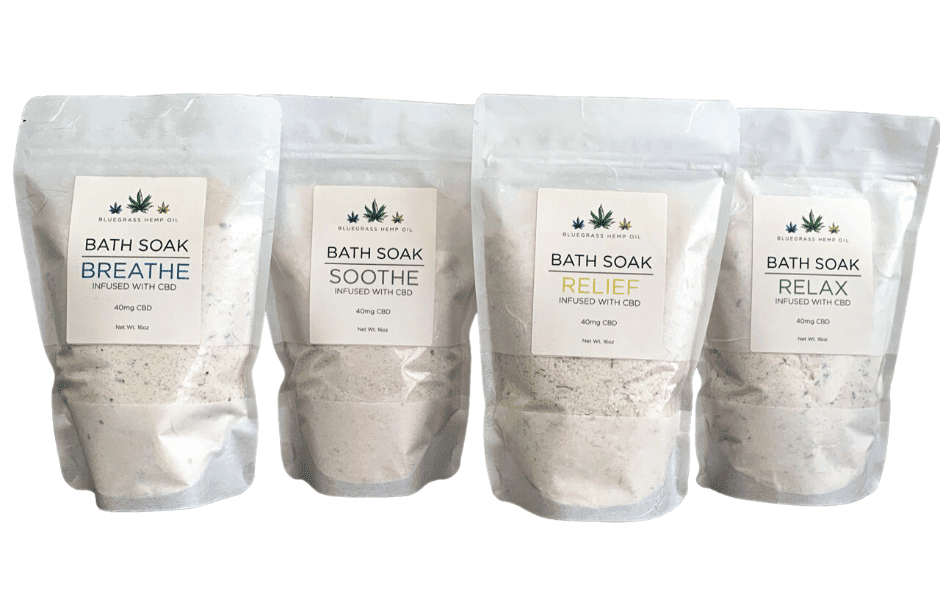
Bluegrass Hemp Oil CBD bath soak collection shown as external-use bath products

Product names such as Breathe, Soothe, Relief, and Relax are formula or scent names, not treatment promises.

Important safety note: This article is educational and is not medical advice. Bluegrass Hemp Oil bath products are not intended to diagnose, treat, cure, or prevent pain, inflammation, anxiety, stress, sleep problems, cough, sinus issues, skin conditions, muscle soreness, or any disease. Speak with a licensed healthcare professional before using CBD if you take medication, are pregnant or nursing, have a medical condition, have skin sensitivities, or are shopping for a child or dependent.

Author

Bill Polyniak, Bluegrass Hemp Oil

Reader Focus

Ingredients, labels, COAs, THC, and external-use safety

Updated

May 2026

What should you know before using a CBD bath soak?

CBD bath soaks are external-use bath products, not medical treatments. Check the ingredient list, essential oils, fragrance, CBD amount, THC content, warning statements, batch number, and Certificate of Analysis before use. People with sensitive skin, allergies, open cuts, pregnancy, breastfeeding, medication use, or medical conditions should ask a qualified healthcare professional first.

1

Use the label first

Directions, warnings, amount per use, and external-use language matter more than product names or scent names.

2

Review the COA

COAs help you understand cannabinoid content and THC levels, but they do not prove that a bath product treats symptoms.

3

Protect your skin

Essential oils, fragrance, botanicals, colorants, salts, and hot water may irritate sensitive skin.

What Is a CBD Bath Soak?

A CBD bath soak is a bath product that dissolves into warm bath water. It may include bath salts, magnesium salts, sodium bicarbonate, botanicals, carrier oils, fragrance, essential oils, colorants, and hemp-derived CBD.

External-use product

CBD bath soaks should not be swallowed and should be used only as directed on the product label.

Not medical treatment

Bath products should not be used to diagnose, treat, cure, or prevent a medical condition or delay professional care.

Ingredients matter

Review salts, essential oils, fragrance, botanicals, colorants, CBD content, THC content, and warning statements before use.

For related external-use formats, explore CBD topical product education and learn how CBD body-care products are compared.

CBD Bath Soaks vs. CBD Bath Bombs

CBD bath soaks and CBD bath bombs are not the same product format. The safest comparison is based on product type, ingredient review, label clarity, and lab information.

Product typeWhat it isWhat to review
CBD bath soakLoose bath salts or soak blend measured into bath water.Ingredients, amount used, fragrance, essential oils, CBD content, THC content, and Certificate of Analysis.
CBD bath bombSingle-use fizzy bath product.Ingredients, fragrance, colorants, CBD content, THC content, and Certificate of Analysis.
CBD topicalExternal-use cream, balm, lotion, salve, or roller.Ingredients, external-use directions, skin-sensitivity warnings, THC content, and Certificate of Analysis.

What Ingredients Should You Check in a CBD Bath Soak?

Ingredients matter because bath products contact the skin and may contain fragrance, essential oils, botanicals, salts, or colorants. Review the full ingredient list before use, especially if you have sensitive skin, allergies, eczema, psoriasis, open cuts, or a history of irritation.

Bath-product ingredients

Look for bath salts, Epsom salt, sodium bicarbonate, fragrance, essential oils, botanicals, colorants, carrier oils, and potential allergens.

CBD-specific details

Review CBD amount, full-spectrum status, THC content, batch number, and the Certificate of Analysis.

Skin-sensitivity details

Check warnings for broken skin, external use only, eye contact, irritation, allergies, pregnancy, children, pets, and storage.

Before choosing a bath product, read the CBD product label guide and read the CBD quality guide.

Bluegrass Hemp Oil CBD Bath Soak Collection

Bluegrass Hemp Oil CBD bath soaks are external-use bath products made for bath routines and self-care. Each formula has a different scent and ingredient profile. Review the product label, ingredients, THC content, and Certificate of Analysis before use.

Formula-name note: Product names such as Breathe, Soothe, Relief, and Relax should be understood as scent or formula names, not as promises that a product treats symptoms.

✦

Breathe CBD Bath Soak

A bath soak with a refreshing scent profile and external-use bath ingredients. The name should not be read as a respiratory claim.

✦

Soothe CBD Bath Soak

A bath soak with a gentle ingredient profile designed for bath routines. The name should not be read as a pain or inflammation claim.

✦

Relief CBD Bath Soak

A bath soak with a mint-forward or botanical scent profile. The name should not be read as a pain-relief claim.

✦

Relax CBD Bath Soak

A bath soak with a warm scent profile. The name should not be read as stress, anxiety, or sleep support.

How to Use a CBD Bath Soak Safely

Use the product label first. The best bath routine is simple, easy to understand, and designed around safe external use.

Read the label

Review directions, ingredients, amount per use, warnings, batch number, and external-use language.

Check the COA

Review product-specific cannabinoid content and THC levels when a batch-specific report is available.

Use warm, not extreme, water

Very hot baths may increase dizziness, dryness, irritation, or discomfort for some people.

Stop if irritation occurs

Rinse skin and stop use if rash, burning, itching, dizziness, or other concerning symptoms occur.

Use the label first, then view Bluegrass Hemp Oil Certificates of Analysis and read the CBD product label guide for product-specific information.

Can CBD Bath Soaks Make You High?

CBD itself is not typically intoxicating, but full-spectrum CBD bath products may contain trace THC. Review the product label and Certificate of Analysis to understand THC content.

Full-spectrum review

Full-spectrum CBD may contain trace THC within applicable hemp limits. Review product-specific testing before use.

Delta-8 caution

Delta-8 THC is not the same as CBD and may create intoxication risk. Avoid unclear or intoxicating hemp products.

Lab reports matter

COAs help customers review cannabinoid content and THC levels, but they do not prove medical effectiveness.

For more context, understand the difference between CBD and THC, understand full-spectrum CBD products, and review Delta-8 THC safety concerns.

Are CBD Bath Soaks Safe for Sensitive Skin?

CBD bath soaks may not be appropriate for everyone, especially people with sensitive skin, allergies, open wounds, active irritation, or certain skin conditions.

Potential irritants

Essential oils, fragrance, botanicals, colorants, and salts may irritate some skin or trigger allergies.

When to ask first

Ask a dermatologist or qualified clinician if you have eczema, psoriasis, active irritation, open cuts, or a history of skin reactions.

Pregnancy and breastfeeding

FDA strongly advises against using CBD, THC, or marijuana in any form during pregnancy or while breastfeeding.

CBD Bath Product Safety

CBD is not risk-free, and external use does not remove every safety question. People who take medication or have medical conditions should speak with a healthcare professional before using CBD products.

Medication and side effects

CBD may interact with medications and may contribute to drowsiness or other side effects. Use extra caution with alcohol, sedatives, or very hot baths.

Multiple CBD products

Consider total CBD exposure if you use more than one CBD product, such as oils, gummies, capsules, topicals, or bath products.

Storage and household safety

Keep CBD bath products away from children and pets. Stop use if irritation occurs, and seek care if symptoms are concerning.

For deeper safety context, review CBD medication interaction guidance and read how long CBD may stay in your system.

Check the Label, COA, and Lab Testing

A Certificate of Analysis helps customers review product-specific testing information, including cannabinoid content and THC levels. COAs support transparency, but they do not prove that a CBD bath product treats symptoms or disease.

What to reviewWhy it mattersHelpful resource
Product labelShows product name, CBD amount, ingredients, use directions, warnings, batch number, and company contact information.Read the CBD product label guide
Certificate of AnalysisHelps you confirm cannabinoid content and THC levels for a specific product or batch.View Bluegrass Hemp Oil Certificates of Analysis
Lab-testing standardsShows how testing supports transparency and helps customers compare product quality.Learn about CBD lab testing
Product-quality contextHelps you compare ingredients, sourcing, product type, and expectations without relying on medical claims.Read the CBD quality guide
BP

About Bill Polyniak

Bill Polyniak is the founder of Bluegrass Hemp Oil and Kentucky Cannabis Company, and he focuses on practical CBD education, transparent labels, Certificates of Analysis, full-spectrum hemp quality, and responsible product language.

Learn more from Bill Polyniak’s founder profile and the Bluegrass Hemp Oil process and quality standards.

CBD Bath Soaks FAQ

What is a CBD bath soak?

A CBD bath soak is an external-use bath product that combines hemp-derived CBD with bath salts, botanicals, fragrance, essential oils, or other bath ingredients.

Are CBD bath soaks the same as CBD bath bombs?

No. A bath soak is usually a loose bath salt or soak blend, while a bath bomb is a single-use fizzy bath product. Both should be compared by reviewing ingredients, external-use directions, THC content, and a Certificate of Analysis.

Can CBD bath soaks make you high?

CBD itself is not typically intoxicating, but full-spectrum CBD products may contain trace THC. Review the product label and COA to understand product-specific THC content.

Are CBD bath soaks safe for sensitive skin?

They may not be appropriate for everyone. Review essential oils, fragrance, botanicals, salts, colorants, and warning statements before use, especially if you have allergies, open wounds, active irritation, or a history of skin reactions.

Should I use CBD bath soaks while pregnant or breastfeeding?

Pregnancy and breastfeeding require extra caution. FDA strongly advises against using CBD, THC, or marijuana in any form during pregnancy or while breastfeeding.

What should I check before buying a CBD bath soak?

Check the CBD amount, full ingredient list, external-use directions, warning statements, THC content, batch number, company contact information, and product-specific Certificate of Analysis.

What Is the Best Way to Take CBD? Oils, Gummies, Capsules, and Safety

CBD Format Guide

What Is the Best Way to Take CBD? Oils, Gummies, Capsules, and Safety

The best way to take CBD depends on the product format, label directions, CBD amount per serving, THC content, ingredients, personal preferences, and safety considerations. CBD oils, gummies, capsules, and topicals are used differently, so it is important to compare labels, Certificates of Analysis, lab testing, and medication-interaction cautions before choosing a product.

Important: This article is for educational purposes only and is not medical advice. Bluegrass Hemp Oil products are not intended to diagnose, treat, cure, or prevent anxiety, pain, sleep problems, inflammation, stress, seizures, or any disease. Speak with a licensed healthcare professional before using CBD if you take medication, are pregnant or nursing, have a medical condition, have liver concerns, or are subject to drug testing.

Written by
Bill Polyniak
Last updated
May 19, 2026
Guide focus
Consumer CBD format comparison, product-label safety, and Bluegrass Hemp Oil transparency
Start Here

What Is the Best Way to Take CBD?

There is no single best way to take CBD for everyone. The best method depends on the product format, label directions, CBD amount per serving, THC content, ingredients, personal preferences, and safety considerations.

Before choosing any CBD format, read the product label, review the Certificate of Analysis, and consider whether medication, pregnancy, breastfeeding, liver concerns, drug testing, or pet use changes the safety conversation.

Product format matters.
Oils, gummies, capsules, topicals, and pet-labeled products are used differently.
Labels come first.
Serving information helps you understand the label. It is not medical dosage advice.
THC content matters.
Full-spectrum CBD products may contain trace THC.
Safety matters.
CBD may interact with medications and may not be appropriate for everyone.

Helpful next steps: Read the CBD product label guide and Review CBD medication interaction guidance.

Quick Answers

Quick Answers for Choosing a CBD Format

Use these short answers to compare CBD formats without turning product education into medical advice.

Which CBD format is easiest to compare?

CBD oils, gummies, capsules, and topicals can all be compared by reading the label, CBD amount, ingredients, THC content, and Certificate of Analysis.

Is CBD oil better than gummies?

Not automatically. CBD oil gives more serving flexibility, while gummies are pre-portioned. The better fit depends on the label, ingredients, routine, and safety considerations.

What should you check before taking CBD?

Check the serving directions, THC content, ingredients, warning language, batch number, COA, drug-testing concerns, and medication-interaction cautions.

Related resources: read the CBD product label guide, learn about CBD lab testing, and compare CBD oil, gummies, and capsules.

Format Comparison

CBD Oil, Gummies, Capsules, and Topicals Compared

CBD format comparison should focus on how the product is used, what the label says, and which safety factors apply. One format is not automatically better than another.

CBD Format How It Is Used What to Review Safe Takeaway
CBD oil Measured serving, often placed under the tongue before swallowing. Dropper, serving size, carrier oil, THC content, ingredients, and Certificate of Analysis. Flexible format that requires careful label review.
CBD gummies Edible format. CBD per gummy, ingredients, sweeteners, THC content, child-safe storage, and Certificate of Analysis. Convenient format; timing can vary.
CBD capsules Supplement-style format. CBD per capsule, capsule ingredients, THC content, and Certificate of Analysis. Consistent serving format with less flexibility than oil.
CBD topicals External-use format. Ingredients, external-use directions, skin sensitivity warnings, THC content, and Certificate of Analysis. Not intended to treat pain, inflammation, or skin disease.
Pet CBD Pet-labeled product format. Ingredients, THC content, Certificate of Analysis, and veterinarian guidance. CBD is not FDA-approved for animals; speak with a veterinarian.

For deeper comparison, Compare CBD oil, gummies, and capsules, Explore CBD topical product education, and Read the comprehensive guide to CBD for pets.

How to Take CBD Oil

CBD oil is commonly measured with a dropper and used according to the product label. Some CBD oil products are placed under the tongue before swallowing. Always follow the serving directions and review the Certificate of Analysis before use.

CBD Gummies and Capsules

Gummies and capsules are pre-portioned formats. They may be convenient for people who prefer not to measure oil, but users should still review CBD amount per serving, THC content, ingredients, warning language, and COA availability.

CBD Topicals

CBD topicals are external-use products such as creams, balms, salves, lotions, or roll-ons. Review ingredients, external-use directions, skin-sensitivity warnings, THC content, and COA information before use.

Serving Guidance

How Much CBD Should You Take?

Follow the product label. Do not exceed labeled serving directions, and speak with a healthcare professional if you take medication, have liver concerns, are pregnant or nursing, or have a medical condition.

Serving information helps customers understand the product label. It should not be treated as medical dosage advice.

Start by reviewing Read the CBD product label guide.

Timing

How Long Does CBD Take to Notice?

Timing can vary by product format, serving size, food intake, metabolism, THC content, medication use, and product quality. CBD oil, gummies, capsules, and topicals are used differently, so there is no guaranteed timing that applies to everyone.

Helpful reference: Read how long CBD may stay in your system.

Food Timing

Should You Take CBD With Food?

Food timing may affect how CBD is absorbed. For everyday product use, the safest practical takeaway is consistency: choose a repeatable routine and avoid changing serving size, timing, and food intake all at once.

Ask a healthcare professional if you take medication or have medical concerns.

Safety First

Can CBD Interact With Medication?

Yes. CBD may interact with prescription medications, over-the-counter drugs, herbs, or supplements. It may also increase drowsiness when combined with alcohol or sedating drugs, and it may raise liver-safety considerations for some people.

  • Speak with a doctor or pharmacist before using CBD if medication is involved.
  • Do not stop, reduce, or change medication without professional guidance.
  • Watch for changes in alertness, appetite, digestion, or mood.
  • Use extra caution with alcohol, sedating drugs, sleep medications, seizure medications, blood thinners, heart medications, mood medications, or multiple medications.

Next steps: Review CBD medication interaction guidance and Read how long CBD may stay in your system.

Special Situations

Pregnancy, Breastfeeding, Children, and Liver Concerns

FDA strongly advises against using CBD, THC, or marijuana in any form during pregnancy or while breastfeeding. Children, adolescents, people with liver concerns, and people taking medication should use extra caution and speak with a qualified healthcare professional.

Keep CBD products away from children. Do not shop for a child or dependent without professional guidance.

THC Review

Full-Spectrum CBD, THC, and Drug Testing

Full-spectrum CBD products may contain trace THC within applicable hemp limits. People subject to workplace, athletic, professional, probation, or other drug testing should review THC content and Certificates of Analysis carefully.

Full-spectrum CBD
May contain trace THC.
Hemp-derived
Does not automatically mean THC-free.
COAs
Help users review THC content.
Delta-8 THC
Is not the same as CBD and may create additional risk.

Helpful resources: Understand full-spectrum CBD products, Understand the difference between CBD and THC, Learn whether CBD can matter for drug testing, and View Bluegrass Hemp Oil Certificates of Analysis.

Pet Safety

Is CBD Safe for Pets?

CBD is not FDA-approved for use in animals. Pet owners should speak with a veterinarian before giving CBD or any supplement to a dog or cat.

  • Human CBD products may contain ingredients unsafe for pets.
  • THC exposure can be dangerous for pets.
  • Do not use CBD to delay veterinary care.
  • Do not use pet serving or timing guidance from a general adult CBD article.

For pet-specific education, Read the comprehensive guide to CBD for pets and Review pet CBD safety considerations.

Trust Check

Check Labels, COAs, and Lab Testing Before Choosing a CBD Format

A CBD product should be easy to understand before you use it. If you cannot find the CBD amount per serving, THC content, ingredients, batch number, or Certificate of Analysis, choose caution.

Product type and serving directions
CBD amount per serving and total CBD per package
THC content and full-spectrum status
Ingredients and warning language
External-use directions for topicals
Batch number, COA, lab testing, and company contact information

Use these resources before choosing a format: Read the CBD product label guide, Learn about CBD lab testing, View Bluegrass Hemp Oil Certificates of Analysis, and Read the CBD quality guide.

Product Family

Genesis Blend Full-Spectrum CBD Oil Options

Genesis Blend is Bluegrass Hemp Oil’s full-spectrum CBD oil product family. Before choosing a bottle size or flavor, review the CBD amount per serving, THC content, ingredients, product label, and Certificate of Analysis.

Bluegrass Hemp Oil Education

Bluegrass Hemp Oil’s Approach to CBD Education and Transparency

Bluegrass Hemp Oil is a Kentucky-based hemp company focused on CBD education, product transparency, lab testing, and quality standards. Our resources help adults compare CBD formats, read product labels, review Certificates of Analysis, understand THC content, and consider safety factors before choosing hemp-derived products.

CBD Product Labels

Understand serving information, ingredients, THC content, and warning language before choosing CBD.

Certificates of Analysis

Review available product-specific lab reports before using a CBD product.

CBD Lab Testing

Learn what lab testing can show about cannabinoid content, THC levels, and product transparency.

CBD Quality Guide

Learn how to evaluate CBD products with a safety-first mindset.

Related Guides

Related CBD Format and Safety Resources

CBD Oil Use Guide

Learn how to use CBD oil with label-first serving guidance.

CBD Oil vs Gummies vs Capsules

Compare common CBD formats and label considerations.

CBD Interactions

Review medication-interaction considerations before using CBD.

CBD Drug Testing

Learn why trace THC may matter for workplace, athletic, licensing, or other testing.

You can also Review Bluegrass Hemp Oil quality standards or Contact Bluegrass Hemp Oil with product questions.

BP

Bill Polyniak

Founder · Product Developer · CBD Educator

About the author

Consumer CBD education from Bluegrass Hemp Oil

Bill Polyniak helps lead Bluegrass Hemp Oil’s education-first approach to full-spectrum hemp, product transparency, CBD labels, Certificates of Analysis, and practical safety questions. This guide is written to help shoppers compare CBD oil, gummies, capsules, topicals, and pet-related questions without turning product education into medical advice.

Bill’s focus is clear consumer education: understand the format, review the label, confirm batch-specific testing, check THC content, and speak with a qualified professional when medication, pregnancy, breastfeeding, liver concerns, drug testing, pets, or medical conditions are involved.

Learn more about Bill Polyniak and Bluegrass Hemp Oil, review Bluegrass Hemp Oil quality standards, or contact Bluegrass Hemp Oil with product questions.

FAQ

Frequently Asked Questions

What is the best way to take CBD?

The best way to take CBD depends on the product format, label directions, CBD amount per serving, THC content, ingredients, and safety considerations.

Is CBD oil better than gummies?

CBD oil and gummies are different formats. CBD oil is measured with a dropper, while gummies are pre-portioned edibles. One is not automatically better for everyone.

Are CBD capsules different from CBD oil?

Yes. CBD capsules are pre-portioned supplement-style products, while CBD oil is measured before use and may offer more serving flexibility.

How do I take CBD oil?

Follow the product label. CBD oil is commonly measured with a dropper and used according to the serving directions on the bottle.

How long does CBD take to notice?

Timing can vary by product format, serving size, food intake, metabolism, medication use, and product quality. There is no guaranteed timing that applies to everyone.

Should I take CBD with food?

Food timing may affect CBD absorption. The most practical approach is consistency: choose a repeatable routine and avoid changing multiple variables at once.

How much CBD should I take?

Follow the product label and do not exceed labeled serving directions. Speak with a healthcare professional if you take medication, have liver concerns, are pregnant or nursing, or have a medical condition.

Can CBD interact with medication?

Yes. CBD may interact with prescription medications, over-the-counter drugs, herbs, or supplements. Speak with a doctor or pharmacist before using CBD if you take medication.

Can full-spectrum CBD contain THC?

Yes. Full-spectrum CBD products may contain trace THC within applicable hemp limits. Review the product label and Certificate of Analysis before use.

Can CBD show up on a drug test?

CBD itself is not usually the target of standard drug tests, but full-spectrum CBD may contain trace THC, which can matter for drug testing.

Is CBD safe for pets?

CBD is not FDA-approved for use in animals. Pet owners should speak with a veterinarian before giving CBD or any supplement to a dog or cat.

What should I check before taking CBD?

Review the product label, CBD amount per serving, ingredients, THC content, serving directions, warnings, batch number, Certificate of Analysis, and lab-testing information.

Sources

Sources and Further Reading

This guide is educational and should be reviewed alongside current regulatory and health information. For medical questions, speak with a licensed healthcare professional.

Help CBD Help You

Help CBD Help You

Bluegrass Hemp Oil CBD Routine Guide

Quick Answer: How Do You
Help CBD Help You?

The best way to help CBD help you is to choose the right product format, read the label carefully, compare CBD per serving, check THC content, review the batch-specific Certificate of Analysis, keep your routine consistent, and track your experience without expecting CBD to treat medical conditions.

CBD is not risk-free, may interact with medications, and may not be appropriate for everyone. Start with a label-guided, COA-verified routine and ask a qualified healthcare professional when safety questions apply.

Fast summary

Key Takeaways

Start with the label

The CBD label should explain product type, CBD per serving, ingredients, directions, warnings, batch or lot information, and COA access.

No universal serving size

There is no single CBD serving size for everyone. Compare CBD per serving and follow the product label rather than guessing from bottle size.

Verify full-spectrum details

Full-spectrum CBD may contain trace THC. Review the COA before use, especially if THC sensitivity or drug testing matters.

Ask safety questions early

CBD may interact with medications and may increase drowsiness with alcohol or sedating products. Healthcare guidance may be needed.

Track the routine

Consistency helps you compare format, timing, food pattern, CBD per serving, and personal preference without self-treating symptoms.

Avoid condition claims

CBD products should not be promoted as treating anxiety, pain, inflammation, sleep disorders, seizures, pet behavior concerns, or any medical condition.

Expectation setting

What This Guide Means by “Help CBD Help You”

“Help CBD help you” does not mean using CBD to treat a disease or replace medical care. It means making a more informed product decision by checking the format, label, CBD per serving, THC content, ingredients, batch-specific COA, and safety warnings before building a consistent routine.

Claim safety note

CBD should not be described as treating, curing, preventing, reducing, or managing medical conditions. This guide focuses on product fit, label clarity, COA verification, safety questions, and professional guidance.

Entity summary

CBD Routine Terms to Know

These terms help you compare CBD products without relying on unsupported condition claims.

EntitySimple ExplanationWhy It Matters
CBD routineRepeatable way someone uses a CBD productHelps users compare experience consistently
Product labelDirections and product facts on the packageStarting point for responsible use
CBD per servingAmount of CBD in one labeled servingHelps compare products
Full-spectrum CBDCBD plus other hemp compounds and possible trace THCImportant for THC and COA review
Broad-spectrum CBDMultiple hemp compounds, typically without THCUseful for THC-avoidance shoppers
CBD isolateCBD-only product typeUseful for simple CBD-only comparison
COACertificate of AnalysisVerifies CBD, THC, cannabinoids, and testing
Trace THCSmall THC amount possible in full-spectrum CBDRelevant for drug testing and THC sensitivity
Medication interactionCBD may affect how some drugs are processedHealthcare guidance may be needed
Product formatOil, gummy, capsule, topical, edible, or pet productDetermines routine fit

Label first

Start With the Product Label

A CBD label should help you understand what you are using before you begin a routine. Do not judge a product by bottle size, flavor, or marketing claims alone. Start with CBD per serving, product type, extract type, THC information, ingredients, directions, warnings, and COA access.

For a deeper walkthrough, use the Bluegrass Hemp Oil guide to how to read a CBD product label.

CBD Label Checklist

  • Product name
  • Product type
  • CBD per serving
  • Total CBD
  • Full-spectrum, broad-spectrum, or isolate status
  • THC information
  • Ingredient list
  • Carrier oil
  • Flavor ingredients
  • Serving directions
  • Safety warnings
  • Batch or lot number
  • Expiration date
  • COA access
  • Company contact information

Product fit

Choose the CBD Format That Fits Your Routine

Different CBD formats fit different routines. The right choice depends on product preference, label directions, CBD per serving, ingredients, THC information, COA access, and safety considerations.

Compare the CBD product guide for oils, gummies, capsules, and topicals and the guide to which CBD delivery method is right for your routine before choosing.

Product FormatBest FitWhat to Check
CBD oilFlexible serving routinesCBD per mL, carrier oil, THC level, COA
CBD gummiesPre-measured edible formatCBD per gummy, sugar, allergens, THC level
CBD capsulesSimple consistent routineCBD per capsule, capsule ingredients, COA
CBD topicalsExternal-use skin and body-care routinesIngredients, fragrance, patch test, total CBD
CBD ediblesFood-style CBD formatCBD per serving, sugar, allergens, onset expectations
Pet CBDPet-owner researchVeterinarian guidance, THC level, pet-specific directions

Serving clarity

Compare CBD Serving Sizes Without Guessing

There is no universal CBD serving size for everyone. Compare products by CBD per serving, product type, THC level, ingredients, label directions, safety warnings, and COA results.

For oil-specific routine questions, review how to take CBD oil safely.

Product TypeWhat to Look ForWhat Not to Do
CBD oilCBD per mL or dropperDo not guess based on bottle size
GummiesCBD per gummyDo not assume all gummies are equal
CapsulesCBD per capsuleDo not combine formats without checking total CBD
TopicalsTotal CBD, container size, ingredientsDo not compare like oral products
Full-spectrum productsTHC level and COADo not ignore drug-testing concerns

Consistency

Keep Your CBD Routine Consistent

A consistent CBD routine makes it easier to compare product fit, timing, serving size, food timing, and personal preference. Track your routine without using CBD as a substitute for medical care.

What to TrackWhy It Helps
Product nameKeeps the routine clear
CBD per servingHelps avoid guessing
Product formatOil, gummy, capsule, edible, or topical
Time of dayHelps compare routine consistency
Food timingMay influence absorption
THC contentImportant for full-spectrum products
Batch numberHelps match the COA
NotesHelps track personal preference without making medical claims

Timing and absorption

CBD Oil With Food, Timing, and Absorption

Food timing, product format, carrier oil, and consistency can affect a CBD routine. Keep your routine consistent and avoid changing too many variables at once.

For more context, review CBD absorption and bioavailability explained and the MCT oil and CBD carrier oil guide.

Routine QuestionSafer Answer
Should I take CBD with food?CBD is fat-soluble, so food timing may influence absorption. Keep the pattern consistent.
Should I change serving size quickly?No. Follow the label and avoid changing too many variables at once.
How long should I track a routine?Track consistently before judging product fit, unless side effects or safety concerns occur.
Can I combine CBD formats?Check total CBD, THC, and ingredients before combining formats.
Should I use CBD with alcohol?Use caution. CBD may increase drowsiness with alcohol or sedating products.

Full-spectrum context

Full-Spectrum CBD, Trace THC, and Drug Testing

Full-Spectrum CBD and THC

Full-spectrum CBD products may contain trace THC within legal hemp limits. CBD itself is not usually the target of standard drug testing, but THC exposure can matter for workplace, athletic, legal, medical, military, probation, or professional testing programs. No CBD company should guarantee that a full-spectrum CBD product will not affect a drug test. Review the COA before use.

Use these guides for more context: what full-spectrum CBD means and hemp vs marijuana and THC differences.

Important claim boundary

What CBD Should Not Be Claimed to Treat

CBD Claim Caution

Do not claim that Genesis Blend, full-spectrum CBD oil, CBD gummies, CBD capsules, CBD topicals, or pet CBD products diagnose, treat, cure, prevent, reduce, or manage anxiety, panic attacks, depression, OCD, ADHD, pain, inflammation, kidney stones, nerve pain, sleep disorders, headaches, neuropathy, focus problems, nausea, hangovers, seizures, dog aggression, or any medical or veterinary condition. A safer page should explain product type, label directions, CBD per serving, safety questions, COAs, and professional guidance.

YMYL safety

CBD Safety: Medications, Liver, Drowsiness, Alcohol, Pregnancy, and THC

CBD Safety Note

CBD is not risk-free. CBD may interact with medications, may increase drowsiness when combined with alcohol or sedating products, and may not be appropriate for people who are pregnant, nursing, taking prescriptions, managing liver concerns, or managing a medical condition. Full-spectrum CBD may contain trace THC and may create drug-testing concerns. Talk with a qualified healthcare professional before use when needed.

Safety TopicWhy It MattersSafer Guidance
Prescription medicationsCBD may interact with medicationsAsk a qualified healthcare professional
Liver concernsCBD may raise liver-safety questionsGet healthcare guidance before use
AlcoholMay increase drowsiness or impairment concernsAvoid assuming the combination is safe
Sedating productsMay increase sleepinessUse caution and ask a professional
Pregnancy or nursingCBD may not be appropriateAvoid use unless directed by a qualified professional
Drug testingFull-spectrum CBD may contain trace THCReview the COA carefully

Responsible tracking

How to Track Your CBD Routine Responsibly

Tracking your CBD routine can help you compare product fit and consistency. Do not use a tracking journal to self-treat symptoms or delay medical care.

CBD Routine Tracking Checklist

  • Product name
  • Product format
  • CBD per serving
  • Full-spectrum, broad-spectrum, or isolate status
  • THC level from COA
  • Batch number
  • Serving time
  • Food timing
  • Other CBD products used that day
  • Alcohol or sedating products used that day
  • Medication or supplement changes
  • Personal notes
  • Any side effects or concerns
  • Whether healthcare guidance is needed

Verification

How to Check a CBD Certificate of Analysis

A CBD Certificate of Analysis helps verify what is in a specific product batch. Review the COA before building a consistent routine, especially with full-spectrum CBD products.

Use the Bluegrass Hemp Oil pages for CBD lab testing and Certificates of Analysis and to review CBD Certificates of Analysis.

CBD COA Checklist

  • Match the product name.
  • Match the batch or lot number.
  • Confirm CBD amount.
  • Confirm CBD per serving.
  • Check delta-9 THC.
  • Check total THC if provided.
  • Review minor cannabinoids.
  • Look for terpene testing if claimed.
  • Look for pesticide testing.
  • Look for heavy metal testing.
  • Look for residual solvent testing.
  • Look for microbial testing.
  • Check the lab name.
  • Check the testing date.
  • Contact Bluegrass Hemp Oil if anything is unclear.

Buyer checklist

What to Ask Before Buying CBD Online

Before buying CBD online, slow down and compare the product format, CBD per serving, THC information, ingredients, safety warnings, batch-specific COA, and company support. The CBD quality guide for choosing transparent hemp products can help organize those questions.

Buyer Questions Checklist

  • What product format fits my routine?
  • How much CBD is in each serving?
  • Is it full-spectrum, broad-spectrum, or isolate?
  • Does it contain trace THC?
  • Could THC matter for my job, testing, or personal preference?
  • Are the ingredients clear?
  • Is there a batch-specific COA?
  • Does the COA match the product?
  • Are contaminant panels included?
  • Do I take medications or have a health condition?
  • Am I pregnant, nursing, or managing liver concerns?
  • Do I need to ask a healthcare professional before use?

Vet-first safety

Pet CBD: Why Veterinary Guidance Comes First

Pet CBD Safety

Do not use this guide to claim CBD treats pet anxiety, seizures, aggression, pain, arthritis, inflammation, or behavior problems. Pet CBD questions should start with a licensed veterinarian. Full-spectrum pet products may contain trace THC, and animals may respond differently to cannabinoids than humans.

Use this internal safety resource for CBD for pets vet guidance, safety, THC, and COAs.

Brand transparency

How Bluegrass Hemp Oil Supports Product Transparency

Bluegrass Hemp Oil supports shoppers through product education, clear labels, batch-specific COAs, lab testing information, full-spectrum CBD education, and customer support. Product transparency should not be used as a medical claim.

Author and brand context Bill Polyniak

Founder of Bluegrass Hemp Oil and Kentucky Cannabis Company

E-E-A-T support

About the Author and Bluegrass Hemp Oil

Bluegrass Hemp Oil was founded by Bill Polyniak and his family after their personal experience searching for reliable hemp-derived CBD products. Today, Bluegrass Hemp Oil focuses on Kentucky-grown hemp, full-spectrum CBD oil education, transparent product labeling, batch-specific Certificates of Analysis, and customer support.

This guide is written to help shoppers understand CBD routines, product labels, CBD per serving, full-spectrum CBD, trace THC, COAs, and safety questions without relying on unsupported medical claims. Bill Polyniak’s role on this page is to provide brand and product-process context, not medical advice.

Safe product pathway

Compare CBD Products With Your Routine in Mind

If you are comparing CBD products, focus on product format, CBD per serving, THC information, ingredients, batch-specific COA, contaminant testing, and company support rather than claims about treating conditions.

Shop by Product Format

Browse CBD oils, gummies, capsules, topicals, and other formats with routine fit and verification in mind.

FAQ

Frequently Asked Questions

How do I help CBD help me?

Start with the product label, compare CBD per serving, check THC content, review the COA, choose a product format that fits your routine, and track your routine consistently without expecting CBD to treat medical conditions.

Is there a universal CBD serving size?

No. There is no universal CBD serving size for everyone. Compare products by CBD per serving, product type, THC level, ingredients, label directions, and safety warnings.

Should I use CBD oil, gummies, or capsules?

CBD oil may fit people who want flexible serving routines. Gummies are pre-measured edible products. Capsules are simple routine-based formats. Compare labels, ingredients, THC levels, and COAs before choosing.

Should I take CBD oil with food?

CBD is fat-soluble, so food timing may influence absorption. A consistent routine is more useful than changing food timing every day.

Can CBD interact with medications?

Yes. CBD may interact with medications. Speak with a qualified healthcare professional before use if you take prescriptions, manage liver concerns, use sedating products, drink alcohol, or manage a medical condition.

Can full-spectrum CBD contain THC?

Yes. Full-spectrum CBD may contain trace THC within legal hemp limits. Review the product COA for the exact THC level.

Can CBD show up on a drug test?

CBD itself is not usually the target of standard drug tests, but full-spectrum CBD may contain trace THC. THC exposure can matter for workplace, athletic, legal, medical, military, probation, or professional testing programs.

What should a CBD product label show?

A clear CBD label should show product type, CBD per serving, total CBD, ingredients, THC information, serving directions, warnings, batch number, expiration date, and COA access.

What is a CBD COA?

A COA, or Certificate of Analysis, is a lab report that helps verify CBD amount, THC level, cannabinoid profile, and contaminant testing for a specific product batch.

Can I give CBD to my pet?

Talk with a licensed veterinarian before giving CBD to a pet. Do not use human CBD products for pets unless your veterinarian is directly involved.

Final takeaway

Final Takeaway

The best way to help CBD fit your routine is to compare product format, CBD per serving, THC information, ingredients, safety warnings, batch-specific COAs, and company support. CBD should not be used as a substitute for medical care, and it should not be promoted as a treatment for anxiety, pain, inflammation, sleep problems, nausea, seizures, pet behavior problems, or any medical or veterinary condition.

Educational note: This page is for consumer education and product-comparison support. It is not medical or veterinary advice. Ask a qualified healthcare professional about CBD if you take medications, manage a medical condition, are pregnant or nursing, have liver concerns, use sedating products, drink alcohol, or are subject to drug testing.