Hemp Seed Oil vs CBD Oil

Hemp Seed Oil vs CBD Oil

Hemp Product Comparison Guide

Hemp Seed Oil vs CBD Oil: What’s the Difference?

Hemp seed oil and CBD oil both come from hemp, but they are not the same product. Hemp seed oil is made from hemp seeds and does not naturally contain CBD. CBD oil is made from cannabinoid-rich hemp extract, usually from the flower or aerial parts of the plant.

This guide explains the difference between hemp seed oil, hemp oil, hemp extract, CBD oil, and full-spectrum CBD oil so you can read labels more confidently and choose the right product for your goals.

Safety note: This page is educational only. CBD is not risk-free, can interact with medications, and is not intended to diagnose, treat, cure, or prevent disease.

Clear hemp product education Label-reading guidance Full-spectrum CBD explanation Third-party lab testing guidance Kentucky-grown CBD transparency
Hemp Seed Oil CBD Oil CBD Seeds + fatty acids Extract + COA Read the label before you buy.

Clean comparison visual showing hemp seeds, CBD oil, and label verification. Avoid product labels that hide CBD content behind vague “hemp oil” wording.

Quick Answer: Is Hemp Seed Oil the Same as CBD Oil?

No. Hemp seed oil is not the same as CBD oil. Hemp seed oil is pressed from hemp seeds and is commonly used as a food ingredient, skincare ingredient, or carrier oil. It does not naturally contain CBD.

Simple takeaway: If the label only says “hemp seed oil,” do not assume it contains CBD. Look for clear CBD milligrams, cannabinoid information, and a certificate of analysis.

Who Created This Hemp Product Guide?

This guide was created by the Bluegrass Hemp Oil Education Team to help shoppers understand hemp product labels, compare hemp seed oil with CBD oil, and choose hemp-derived products with more confidence.

BHO

Bluegrass Hemp Oil product education

Last reviewed: May 2026. Bluegrass Hemp Oil is a Kentucky hemp company focused on full-spectrum CBD education, transparent labeling, third-party lab testing, and customer guidance.

Bill Polyniak, Founder of Bluegrass Hemp Oil and Kentucky Cannabis Company, has worked in Kentucky hemp since 2014. His education-first approach emphasizes full-spectrum hemp sourcing, product transparency, lab testing, and helping customers understand what is actually in the bottle.

Read Bill Polyniak’s bio | CBD lab testing | Certificates of Analysis | CBD quality guide

Hemp Seed Oil vs CBD Oil at a Glance

FeatureHemp Seed OilCBD Oil
Where it comes fromPressed from hemp seeds.Made from hemp extract, usually from the flower or aerial parts of the plant.
Does it contain CBD?No, not naturally.Yes, if properly labeled and formulated.
Main componentsFatty acids and nutrients from hemp seeds.CBD, and possibly other cannabinoids and terpenes depending on product type.
Common usesFood ingredient, skincare, carrier oil, nutrition-focused products.Hemp-derived cannabinoid product used by consumers as part of a wellness routine.
Testing neededFood or cosmetic quality standards may apply depending on use.Should include third-party cannabinoid and contaminant testing.
Label red flagMarketed as “hemp oil” without CBD milligrams.No COA, unclear THC content, no batch number, or disease-treatment claims.

This is the clearest way to answer common questions such as “Does hemp seed oil have CBD in it?” and “Many shoppers ask whether hemp oil and CBD are the same thing.”

What Is Hemp Seed Oil?

Hemp seed oil is made by pressing the seeds of the hemp plant. It is often used as a food ingredient, cooking oil for low-heat or cold applications, skincare ingredient, carrier oil, or nutritional oil.

Hemp seed oil may contain fatty acids and other seed-derived nutrients, but it does not naturally contain CBD because CBD is found in meaningful amounts in the resin-rich parts of the hemp plant, not the seed.

SEED

Source

Pressed from hemp seeds, not cannabinoid-rich flower.

FA

Main components

Fatty acids and seed-derived nutrients, not CBD.

USE

Common role

Food, skincare, carrier oil, or nutrition-focused ingredient.

Buyer clarity: Hemp seed oil can be useful, but it should not be confused with CBD oil. If you are shopping for CBD, hemp seed oil alone is not the same thing.

External source: FDA hemp seed-derived ingredient information.

What Is CBD Oil?

CBD oil is a hemp-derived product made with cannabidiol, commonly called CBD. CBD is a compound found in cannabis and hemp plants. CBD itself is not intoxicating, meaning it does not cause the “high” associated with THC.

CBD oil products may be made with CBD isolate, broad-spectrum hemp extract, or full-spectrum hemp extract. Full-spectrum CBD products may include CBD, minor cannabinoids, terpenes, and trace THC within legal limits.

Because CBD products vary widely, shoppers should review the label and certificate of analysis before buying. Learn more about CBD oil, full-spectrum CBD, and CBD vs THC.

Plant-part difference: The difference between cannabidiol vs fatty acids in hemp plants is the difference between a cannabinoid product and a seed-oil ingredient. Hemp seed oil supplies seed-derived oils. CBD oil should show verified cannabinoid content.

External source: CDC information about CBD.

The Key Differences Between Hemp Seed Oil and CBD Oil

They come from different parts of the hemp plant. Hemp seed oil comes from the seeds. CBD oil comes from hemp extract, which is associated with the cannabinoid-rich parts of the plant.

Hemp seed oil does not naturally contain CBD. If a product only lists hemp seed oil and does not show CBD milligrams or a cannabinoid lab report, it should not be assumed to be CBD oil.

CBD oil should show cannabinoid content. A trustworthy CBD product should clearly identify the amount of CBD per serving or per bottle and provide a certificate of analysis.

They have different roles. Hemp seed oil is often used for nutrition, skincare, or as a carrier oil. CBD oil is evaluated for CBD content, THC content, product type, and lab testing.

The word “hemp oil” can be confusing. Some brands use the phrase “hemp oil” in a way that confuses shoppers. Always check whether the product contains CBD or whether it is only hemp seed oil.

Label Clarity

Why “Hemp Oil” Labels Can Be Confusing

The phrase “hemp oil” can mean different things depending on the product. Sometimes it means hemp seed oil. Sometimes it is used casually to describe CBD oil. This creates confusion for shoppers who are trying to compare products.

Do not rely on the front label alone. Read the supplement facts, ingredients, CBD milligrams, batch number, and certificate of analysis.

!

Common label issue

“Why is my CBD oil called hemp seed oil?” If the product only lists hemp seed oil, it may not contain CBD.

AMZ

Marketplace confusion

“Is hemp oil the same as CBD oil on Amazon?” Marketplace hemp oil labels can be confusing, so check CBD milligrams and COAs.

The product says “hemp oil” but does not list CBD milligrams.
The product only lists hemp seed oil in the ingredients.
There is no certificate of analysis.
There is no batch number.
The product makes disease-treatment claims.
The THC content is unclear.
The label does not explain whether it is full-spectrum, broad-spectrum, or isolate.
The seller avoids clear answers about testing.

Helpful reads: Amazon hemp oil vs CBD oil and how to read a CBD product label.

How to Tell Whether a Product Is Really CBD Oil

If you are shopping for CBD oil, look for specific information instead of broad hemp marketing language. This is how to read a hemp product label for CBD content.

  • Does the label clearly say CBD?
  • Does it list CBD milligrams per serving or per bottle?
  • Does it say full-spectrum, broad-spectrum, or isolate?
  • Does it list THC content?
  • Is there a batch number?
  • Is there a third-party certificate of analysis?
  • Does the COA match the product batch?
  • Does the COA test for CBD and THC?
  • Does the COA test for pesticides?
  • Does the COA test for heavy metals?
  • Does the COA test for residual solvents?
  • Does the COA test for microbes or contaminants?
  • Are all ingredients listed?
  • Does the brand avoid disease-treatment claims?
  • Is there real customer support?
Extraction difference: Cold-pressed hemp seed oil vs CO2 extraction is one way to think about the difference. Seed oil is pressed from seeds, while CBD oil is made from hemp extract. Phytocannabinoid-rich hemp oil vs seed oil should always be verified through the label and COA.

Review CBD lab testing, Certificates of Analysis, and the CBD quality guide.

Should You Choose Hemp Seed Oil or CBD Oil?

Choose hemp seed oil if...Choose CBD oil if...
You want a hemp seed-derived food or skincare ingredient.You specifically want a product that contains CBD.
You are looking for fatty acids from hemp seeds.You want a cannabinoid product with verified CBD content.
You do not need a cannabinoid product.You want to compare full-spectrum, broad-spectrum, or isolate options.
The ingredient list clearly says hemp seed oil.The label and COA clearly list CBD and THC content.
You are using it as a carrier oil or topical ingredient.You want a third-party tested hemp extract product.
Safety reminder: CBD is not risk-free. Speak with a qualified healthcare professional before using CBD if you are pregnant, nursing, taking medications, managing a medical condition, or subject to drug testing.

Questions like “Hemp seed oil vs CBD oil for anxiety and pain,” “Can I use hemp seed oil instead of CBD for sleep?” or “Is hemp seed oil a waste of money for pain relief?” should be handled carefully. Neither hemp seed oil nor nonprescription CBD should be purchased as a treatment for a medical condition.

How Bluegrass Hemp Oil Helps Customers Avoid Confusion

Bluegrass Hemp Oil focuses on clear hemp education, full-spectrum CBD product transparency, and third-party lab testing. We want customers to understand the difference between hemp seed oil, hemp extract, and CBD oil before they buy.

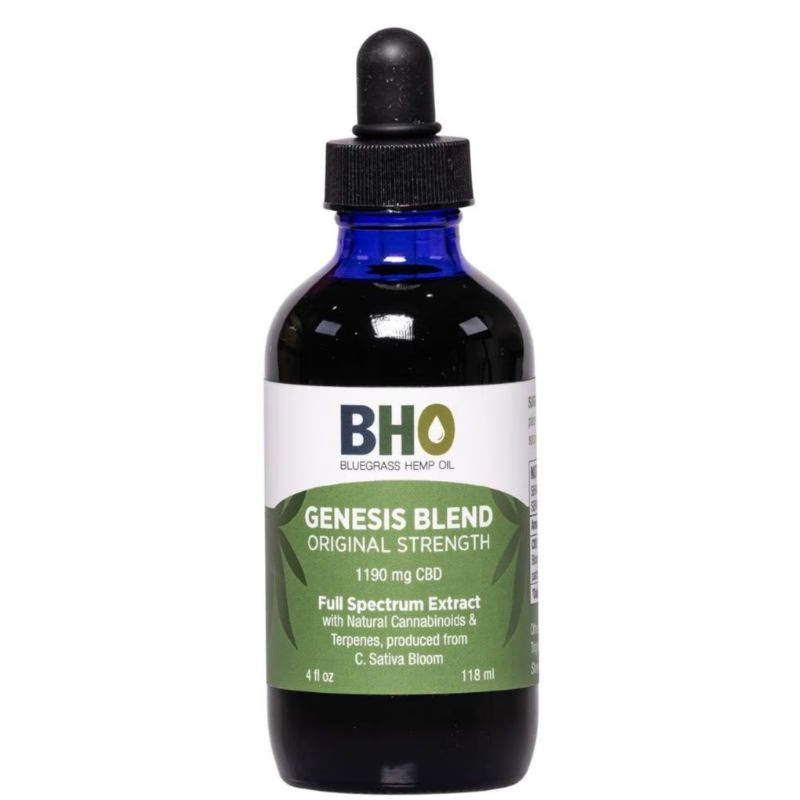
Genesis Blend Full-Spectrum CBD Oil is made for customers who want a Kentucky-grown, full-spectrum CBD product with clear product information and certificates of analysis. It is not the same as plain hemp seed oil.

KY

Kentucky authority

Best Kentucky grown CBD oil for beginners starts with label clarity, customer support, and transparency.

COA

Farm-to-bottle clarity

Farm-to-bottle CBD oil transparency means reviewing sourcing, processing, and batch-specific testing.

LEX

Local education

For real full spectrum CBD oil in Lexington, KY, choose products with clear labels and accessible COAs.

Trace THC note: Full-spectrum CBD products may contain trace THC. Anyone subject to drug testing should review the certificate of analysis and consider avoiding THC-containing products.

Genesis Blend Full-Spectrum CBD Oil | Our Process | Certificates of Analysis

Related Hemp and CBD Education Resources

These resources support the CBD oil, full-spectrum CBD, and product label education cluster without rushing shoppers into a purchase.

CBD Oil

Learn what CBD oil is and how to evaluate it.

Read Guide

Full-Spectrum CBD

Understand full-spectrum hemp extract and trace THC considerations.

Read Guide

CBD vs THC

Compare CBD and THC before choosing a hemp product.

Compare

How to Read a CBD Product Label

Learn what to check before buying CBD.

Read Guide

CBD Lab Testing

See why third-party testing matters.

View Testing

Certificates of Analysis

Review product testing and cannabinoid information.

View COAs

Amazon Hemp Oil vs CBD Oil

Learn why marketplace hemp oil labels can be confusing.

Read Guide

Genesis Blend Full-Spectrum CBD Oil

Explore Kentucky-grown, full-spectrum CBD oil.

View Product

Frequently Asked Questions About Hemp Seed Oil vs CBD Oil

Is hemp seed oil the same as CBD oil?

No. Hemp seed oil is pressed from hemp seeds and does not naturally contain CBD. CBD oil is made with hemp extract that contains cannabidiol, or CBD.

Does hemp seed oil contain CBD?

Hemp seed oil does not naturally contain CBD. If you are shopping for CBD, look for clear CBD milligrams on the label and a certificate of analysis that verifies cannabinoid content.

Why do some products say hemp oil instead of CBD oil?

The term hemp oil can be unclear. It may refer to hemp seed oil, or it may be used casually by some brands to describe CBD oil. Always check the ingredients, CBD milligrams, and lab report.

Is hemp seed oil useful?

Hemp seed oil can be useful as a food ingredient, skincare ingredient, or carrier oil. It is different from CBD oil because it does not naturally contain cannabinoids like CBD.

How do I know if a product is real CBD oil?

Look for CBD milligrams, product type, THC content, a batch number, and a third-party certificate of analysis. The COA should match the product batch and verify cannabinoid levels.

Can full-spectrum CBD oil contain THC?

Yes. Full-spectrum CBD oil may contain trace THC within legal limits. Anyone subject to drug testing should review the certificate of analysis and consider avoiding THC-containing products.

Can CBD interact with medications?

Yes. CBD can interact with some medications. Speak with a qualified healthcare professional before using CBD if you take prescription or over-the-counter medications.

Which is better, hemp seed oil or CBD oil?

Neither is automatically better. Hemp seed oil and CBD oil serve different purposes. Hemp seed oil is a seed-derived ingredient. CBD oil is a cannabinoid product. The right choice depends on what you are looking for.

Can I use hemp seed oil instead of CBD for sleep?

Hemp seed oil is not CBD oil and should not be purchased as a sleep product. CBD products should also not be treated as sleep medicine. If sleep is a health concern, speak with a qualified healthcare professional.

Choose Hemp Products With Clear Labels and Lab Testing

Hemp seed oil and CBD oil are not the same. If you want CBD, do not rely on vague “hemp oil” claims. Look for clear CBD content, full ingredient information, THC details, and third-party certificates of analysis.

Bluegrass Hemp Oil provides Kentucky-grown full-spectrum CBD products with transparent product information and lab testing so customers can understand what they are buying.

FDA Disclaimer

These statements have not been evaluated by the Food and Drug Administration. Bluegrass Hemp Oil products are not intended to diagnose, treat, cure, or prevent any disease. This content is for general education only and is not medical advice. Consult a qualified healthcare professional before using CBD if you are pregnant, nursing, taking medications, managing a medical condition, or subject to drug testing. Keep all cannabinoid products out of reach of children and pets.

Sources and Further Reading

Full Spectrum Living with CBD – Health Nutrition and CBD Part 2

Full Spectrum Living with CBD – Health Nutrition and CBD Part 2

The Full Spectrum Living with CBD trio, Adriane, Jessica, and Meredith, bring back Amanda Nighbert to further discuss health nutrition and CBD. They discuss the importance of Omega 3, EPA, and how it links to gut health and the endocannabinoid system. Food and CBD have become an increasingly popular combination in recent years as research demonstrates the potential synergistic benefits of both on human health and well-being. Together, the two can create a powerful and effective balance in relieving physical ailments, helping to reduce inflammation and provide greater mental clarity. Many have experienced relief from joint and muscle aches, better digestion, and even relief from certain mood disorders such as depression and anxiety. While the research is still new, more studies find that combining CBD and proper nutrition can increase overall health and well-being, including better sleep, improved appetite, and more balanced metabolism. Ultimately, food and CBD provide a robust and complementary tool for supporting a person’s holistic wellness.

Why You Should Incorporate CBD Into Your Health and Nutrition Routine

Good health and nutrition are essential to living a happy and healthy life. The choices we make on what we eat, how much we exercise, and how we take care of our bodies can profoundly affect our wellbeing. One increasingly popular supplement that many people are incorporating into their health and nutrition routine is CBD. CBD, or cannabidiol, is a naturally occurring compound found in hemp plants with a wide range of potential health benefits.

What are omegas?

Omega fatty acids are essential fatty acids that the human body cannot produce on its own and must therefore be obtained through dietary sources. There are three main types of omega fatty acids, Omega 3, 6, and 9. These are essential fatty acids as they play an important role in various bodily functions, such as maintaining healthy cell membranes, regulating hormone production, regulating inflammation, and maintaining homeostasis in the body.

What are the benefits of taking omega supplements?

Omega supplements are an essential part of many health and nutrition routines. Omega fatty acids are a group of polyunsaturated fats linked to numerous health benefits, including improved cardiovascular health, better mental clarity, and a more robust immune system. Omegas are essential for cell membrane health, cognitive performance, and reducing inflammation. They also play an integral role in the body's homeostasis, which is maintaining a consistent internal environment despite external changes. The endocannabinoid system is also affected by omega supplements; they can help to boost the production of cannabinoid receptors and improve their function.

How does proper nutrition affect your health?

When it comes to your health, nutrition plays an integral role. Eating a balanced diet that contains various nutrients is essential to achieving and maintaining good health. When it comes to your overall health, specific vitamins, minerals, and fatty acids are especially important. These include omega-3 fatty acids and other essential fatty acids. When consumed in the right amounts, they can positively impact your health.
When it comes to health nutrition and CBD, proper nutrition is vital. A balanced diet consisting of whole foods that contain various vitamins, minerals, and essential fatty acids can help you reach and maintain optimal health. Proper nutrition helps to strengthen your immune system and protect you from disease. Eating a balanced diet also helps ensure that your body has the fuel to function correctly and that you get all the necessary nutrients for good health.

One way to ensure you’re getting enough of the essential vitamins and minerals is by supplementing with omega-3 fatty acids. Omega-3 fatty acids are essential for many bodily functions, including brain health, cardiovascular health, and the maintenance of healthy cells. Studies have also found that omega-3 fatty acids may be beneficial for treating depression and anxiety. The best sources of omega-3s are fish oil, flaxseed oil, hemp seed oil, and chia seeds.

CBD can also be a valuable addition to your health and nutrition routine. CBD is non-psychoactive, meaning it won’t get you high. Instead, it can restore balance in the body and promote homeostasis. Studies have found that CBD can benefit pain management, inflammation, insomnia, mood, and even mental health issues such as anxiety and depression. Additionally, CBD has been shown to have anti-inflammatory properties, which could help reduce the risk of some chronic diseases.

In conclusion, proper nutrition is essential for optimal health. A balanced diet that contains vital vitamins, minerals, and fatty acids is necessary for solid immunity and protection from disease. Additionally, supplementing with omega-3s can provide numerous benefits for both physical and mental health. Furthermore, CBD can be a valuable addition to your health and nutrition routine; it can help restore balance in the body and provide potential benefits for various health issues.

How can CBD help to restore homeostasis in the body?

CBD, or cannabidiol, is an increasingly popular supplement for its potential to restore balance in the body and promote overall health and wellness. It has been used for centuries as a natural remedy for various ailments and conditions. Still, more recently it has been studied for its ability to help restore homeostasis in the body. Homeostasis is the state of balance and equilibrium within the body, and when this balance is disrupted, it can lead to various health issues.
CBD interacts with our body’s endocannabinoid system, which is critical in regulating the body’s physiology and maintaining homeostasis. CBD works by influencing the endocannabinoid system to produce more endocannabinoids, which act on cannabinoid receptors to create balance in the body. This helps to restore homeostasis, as well as provide relief from symptoms of numerous ailments and conditions.

Studies have shown that CBD can help to regulate mood, reduce inflammation, improve sleep, alleviate pain, and reduce stress. All of these are essential factors in maintaining homeostasis in the body, and CBD can play a significant role in restoring balance. Furthermore, CBD can be even more effective in restoring homeostasis when combined with proper nutrition. Adequate nutrition is essential for optimal health and wellness, and when paired with CBD, it can provide the body with the right environment to maintain balance and health.

The Shocking Truth About CBD vs. THC

Have you ever wondered what the shocking truth is about CBD vs. THC? Are you looking for the differences between these two potent cannabinoids? In this blog post, we will discuss the differences between CBD and THC, as well as THC vs. CBD. We will be exploring the medical benefits of both cannabinoids and which one offers the most beneficial effects for different ailments. By the end of this article, you will better understand the two and be able to make an informed decision on which one is best for your specific needs.  Read the blog The Shocking Truth About CBD vs. THC.

CBN: The Mysterious Degradation Cannabinoid

CBN cannabinoid, known as cannabinol, is being added to CBD products. The CBN cannabinoid is a degradation cannabinoid, a product of the more commonly known cannabinoid THC. CBN is not produced from the Cannabis Sativa plant but rather from the breakdown of the THC molecule. THC is only in trace amounts in hemp, as CBD is the dominant cannabinoid in hemp, and CBN comes from the breakdown process of THC. So, how is it that so much CBN is available to mix with CBD products? Continue here to learn about CBN: The Mysterious Degradation Cannabinoid.

How Much CBD Oil Should I Take To Relax?

Are you looking for a natural way to relax your muscles? If so, you might wonder how much CBD oil you should take to achieve the desired effect. The answer can be complicated, but the good news is that Genesis Blend full spectrum CBD oil is one of the best options for those seeking a natural way to relax. In this blog post, we’ll discuss the potential benefits of CBD oil and how much you should take to relax your muscles. Keep reading to find out more! How Much CBD Oil Should I Take To Relax?

Epidiolex vs. CBD Oil Genesis Blend Hemp CBD Oil

Suppose you are considering using hemp CBD oil as a seizure medication. It is essential to understand the differences between Epidiolex vs. CBD oil Genesis Blend Full Spectrum Hemp Extract available at Bluegrass Hemp Oil and other fine retail establishments.  These two epilepsy medications could help with seizures, but you should know some critical differences before deciding which one is best for you.

This blog post will discuss the similarities and differences between Epidiolex vs. CBD Oil Genesis Blend Full Spectrum hemp extract and how to decide which is the best CBD for seizure medication. We have a family experience using CBD as an epilepsy medication; here is our CBD story. This Epidiolex review vs. Genesis Blend is essential for those looking at CBD as a realistic option as an epilepsy medication. Learn about Epidiolex vs. CBD Oil Genesis Blend Hemp CBD Oil

CBD For Epilepsy

The Polyniaks aren’t the only ones to try their hand at experimenting with CBD to fix their son’s recurrent seizures. Several studies have proven the benefits of CBD for patients with epilepsy. With even more advanced research on the way, more and more doctors are suggesting it as an alternative supplement to combat frequent convulsions. Many studies have demonstrated CBD’s neuroprotective and anti-inflammatory effects, proving a direct correlation between CBD usage and anticonvulsant properties to minimize seizures.

It has been suggested that CBD’s anti-seizure properties may come from the reduction of neuron excitability on two particular receptors. Within your body is a system of neurotransmitters and receptors, more commonly known as your endocannabinoid system. Identified in the 1990s, this internal system helps to regulate bodily functions such as sleep, mood, pain, and immune system functionality. When ingesting CBD, this famous cannabinoid (scientifically known as cannabidiol) binds with receptors within your endocannabinoid system and, in turn, improves the functionality of your mood, appetite, and sleep patterns–over time, bettering a user’s quality of life. Learn more about CBD For Epilepsy.

Oleoresin Extract Verses Isolated Crystalline

A night and day difference exists between full-spectrum CBD vs. CBD isolates. Teamwork makes the dream work – something we at Bluegrass Hemp Oil embody as a company culture and a standard for our cultivation and extraction processes. In other words, quality will forever outshine quantity, and we believe something special about that.

BHO believes in full spectrum use of ALL naturally occurring cannabinoids, terpenes, and flavonoids found in the bloom of the beloved Cannabis flower. Please read our blog on full spectrum vs. whole plant extraction.

Above all, full spectrum means that we do not isolate or eliminate any beneficial components of the plant but instead acknowledge and embrace how each cannabinoid encourages and works with the others. About 100 cannabinoids are known all provide benefits. Although desired results from any particular cannabinoid may potentially prove helpful, several studies have shown a much higher percentage of achieved benefits from an actual full-spectrum extraction versus an isolate. Isolated CBD oil only contains the crystallized CBD molecule. All other benefitting aspects have been removed.  Learn about Oleoresin Extract Verses Isolated Crystalline


  *DISCLAIMER: This is a transcript of episode 16 - Nutrition and CBD - Part 2 from our Full Spectrum Living with CBD podcast. Click here to listen to the episode or click here to watch the video.

Full Spectrum Living with CBD Ep16_ HEALTH NUTRITION AND CBD PART 2

Meredith [00:00:06] Welcome back to Full Spectrum Living with CBD. I am your co-host, Meredith, here with Jessica and Adriane. And you know what? We decided to bring Amanda  Neighbert back with us.

Meredith [00:00:14] This is Amanda Nighbert and she was in our last episode. We had a fantastic conversation about inflammation and choices and health nutrition and CBD. Amanda Neighbert is a dietitian. And so she brought just so much great detail to us. We thought we'd have her back again to continue the conversation around health nutrition and CBD and how it impacts our overall health. But in particular, how it dovetails in with the Endocannabinoid system. So, Jessica, I know you had a couple more questions you wanted to ask of Amanda Neighbert, so why don't we kick it off with you?

Jessica [00:00:42] Yeah, sure. So, you know, recently when we saw Dr. Dustin Sulak speak at the CannMed conference in L.A., one of the questions I got to ask him afterward was about helping my son with his health and his Endocannabinoid system. And he said basically one of the best first steps you could take is really getting your Omega 3 to 6 ratios imbalance. And that that directly impacts the Endocannabinoid system as the Omegas are kind of essentially the building blocks of that system. And if you are intaking way too many Omega 6s, which I think you can speak to, how many more most people are taking, then they should me. But if you're taking too many Omega 6s versus 3s you're essentially building this entire vast system out of faulty bricks. If I'm if I'm understanding his teachings well. So I just wanted to ask, you know, what are some tips on getting a good Omega 3 to 6 balance? Where do you find those in healthy ratios and just general information about Omegas?

Omegas, Health Nutrition and CBD

Amanda [00:01:49] Wow. I mean, actually, that's super interesting to hear him make that connection and also to hear that to be kind of like the number one recommendation that he made. And I love that because I do feel like that Omega 3, Omega 6, balance people don't realize how important that is for overall health. And our lack of Omega 3s in our diet is just really, really sad. So back in the day, you know, when we were hunters and gatherers or before kind of like this whole industrial revolution, the ratio of Omega 3 to Omega 6 was 1 to 1. And that's really, really healthy. Omega 3s really fight inflammation. They really help the body to be healthy.

Omega 6s are necessary, but in large amounts they can actually do more harm than good. Fast forward to today and our actual ratio in some studies showed that we're actually 1 to 15. So for every, you know, gram or whatever of Omega 3s, we're getting fifteen of Omega 6s. And this is probably one of the biggest reasons why people are dealing with so much inflammation in their body. And ultimately it's kind of an easy fix. I mean, it's not an easy fix, but it's definitely fixable. Where do we get a lot of Omega 6 fatty acids? That's what we have to ask ourselves first and foremost. One thing, we're not eating enough Omega 3s, but we're over consuming on Omega 6 fatty acids and we see Omega 6 fatty acids prevalent in processed food, in industrialized foods. So we see them really high in like corn oil.

We talked a little bit about seed oils and that ratio. So, for example, corn oil has a ratio of like 46 to1. So it has 46 Omega 3s to 1 ratio of Omega. Yes, I got to get six guys. OK. Two ones where as we mentioned, hemp oil is like three to one. So much lower ratio of that kind of Omega 6 to that that 3. So a lot of the oils that we use, corn oil, seed oil, you know, those processed vegetable oils are really high in Omega 6. So when we eat a lot of processed foods, they're going to be loaded with those types of oils, which means that they have a much higher ratio of that Omega 6 that we're consuming on a daily basis. I was also talking about even things like the meat we eat. You know, when we eat industrialized conventional meat, they're fed grains, which are really high in Omega 6 is therefore making that meat really high in Omega 6. Whereas if you have like a grass fed cattle, that's actually really high in Omega 3 fatty acids. So Omega 6s is are kind of like all over the place and we get way too many of them in what I call the SAD diet, the Standard American Diet, which is loaded with processed foods.

So the other issue is the fact that we're not consuming enough Omega 3s. So when we look at our diet kind of back in the day, you know, it was loaded in, you know, fish and, you know, again, our cattle back at or our wild meat, ate grass so it was loaded in Omega 3. So we actually had a lot more consumption of Omega 3s. It was more balanced. And now, like we avoid fish because it's loaded with mercury, it's polluted, you know. So a lot of the foods that we think are healthy for us, we don't eat for other reasons. And so that Omega 3 intake gets really, really low. So it's really out of balance. So there's actually like lab testing that you can do to look at your Omega 3 levels. Did you did you know that?

Adriane [00:05:43] No, I didn't know that.

Amanda Neighbert [00:05:44] So there's actually you can actually draw your labs and you can get your levels. You can see what you're DHA is. You can see what your EPA is. It'll actually break down all the Omega 3s and show you what your levels are. Ultimately, it's not really necessary because almost ninety nine percent of the population, your levels are going to be super low. So it's almost better to kind of appropriately supplement with Omega 3 fatty acids and then maybe test  your blood and see where your levels are. The unfortunate part is, is that insurances don't cover this type of testing. Of course

Where to get the best Omega 3's?

Adriane [00:06:24] Of course, right.

Amanda Neighbert [00:06:25] Yes. So I love this topic.

Jessica [00:06:27] I always think, when I think Omega 3s, my go to thoughts are like walnuts and sardines. I don't know what are some other like rich foods cause I'm not a big sardine fan.

Adriane [00:06:37] Not a big sardine fan, right

Amanda Neighbert [00:06:39] Unfortunately like your small fish, like sardines and mackerel and things like that are some of the highest in Omega 3 fatty acids. I love chia seeds. Are really good in Omega 3. Hemp hearts are a good source of Omega 3. Flax seeds have Omega 3. So a lot of those seeds, kind of like you said, walnuts, almonds, things like that are gonna have your Omega 3 fatty acids. So those are kind of my go tos.

Jessica [00:07:10] Chia seeds, I love because it goes back to a previous topic. Does does it not help you with your glycemic index and keeping it more stable? I've always made that association. Is that accurate?

Amanda Neighbert [00:07:21] Yeah, absolutely. We talked about that, you know, on the last episode. But the fiber in chia seeds, the protein and there's Omega fatty acids will help reduce that glycemic response.

Adriane [00:07:34] Again, those Omega 3s and Omega 6s or more so the 3s than anything else, like Jessica said, essentially the building blocks. Right. So you're going to build either the straw house or faulty bricks if you're constantly building with the Omega 6s. And because that's what your body has in abundance. That's what your systems are being built with. So again, to help build and enhance and nurture your Endocannabinoid system, really try to consume more Omega 3s, which is hard, but let's do it right.

Amanda Neighbert[00:08:01] It really is. So, and I I'm not a huge proponent of tons of supplements, but there are three supplements that I think that most people need. I mean, I always say consult your physician, but my top three are magnesium, vitamin D and Omega 3s. You know, just because of the the state of our diet, it's just really hard to get. And when you're looking for Omega 3 supplement, you want to find one that's got more EPA than DHA. We hear a lot about DHA, you know, with regards to like when you're pregnant and it's enhanced in milk. But actually across the board when we do that lab testing, everyone has much lower levels of that EPA than DHA. So making sure your supplement is almost double EPA to DHA is a good idea.

Meredith [00:08:52] Well, I think that's such a such a great point in this whole conversation around the Omegas and even the conversation around inflammation, because I think, Jessica, you and Adriane, your goals are really for your clients and your customers to have fully well-rounded health. And you definitely believe that CBD plays a major, major part in that. But I think it's great that you guys are bringing to light that it's not stand alone, that if you really want CBD to impact your life, you can, you can also make sure to allow that to happen through great nutrition. So, Amanda, are there other areas of nutrition that you really see with your clients? I mean, we've talked about inflammation and we've talked about the Omegas, what's another hot topic for you when it comes to overall nutrition?

Amanda Neighbert [00:09:38] Yeah, I mean, definitely, you know, the umbrella topic is always about reducing inflammation. And I think at the end of the day its just really focusing on as much whole food nutrition as possible. I'm like, don't overthink it. You know, just aim, we talked about the difference between like always trying to take things out of your diet versus adding them in. And I'm all about just adding more. And I think, you know, looking at the foods that you're eating and making them as whole as possible, like they grow in the ground, they have a mother type of thing, is really this the easiest way to, you know, walk towards that overall better health for sure.

Are probiotics a buzz word or real health?

Meredith [00:10:16] It seems like we're hearing a lot, sorry, about about pre and probiotics, too. Is that something that you can talk about?

Amanda Neighbert [00:10:25] Yeah. And I mean, that comes back to, you know, everyone the big buzzword is gut health. And looking at our microbiome and how our gut is working and how that impacts over health, our overall health. And it's really huge, you know, in so many ways. And so a lot of people will come back to probiotics and prebiotics with regards to that. Probiotic, I mean, probiotics are not a catch all. You know, some people respond really well to them and some people don't at all. If you start taking a probiotic and you find that your symptoms actually get worse, like you have more bloating, you have more abdominal issues, more constipation. It could be a sign that you've got some unhealthy bacteria, yeast, candida, that kind of stuff going on that you're probiotic is actually feeding into that negative stuff. So it's not always probiotics are not great for everybody.

Adriane [00:11:25] They're not the silver bullet.

Amanda Neighbert [00:11:26] They're not the silver bullet. Yeah. So, you know, incorporating those and seeing how you react to them is really good. I think the thing with probiotics is that there are over one hundred and fifty beneficial strands of bacteria on the market and you may get a probiotic with one strand. So another suggestion that I always make to my clients is it's not a bad idea to rotate the types of probiotics that you're using so that you have access to as many different strains as you possibly can because, you know, one probiotic may have one or two strands and another may have, you know, 10 to 15 different strains. So having access to all of those different strands is a really good thing. I also love to incorporate foods that have natural probiotics, like I love like kimchi, kraut, fermented foods, Komboucha, kiefer, for you know, those are ways to incorporate probiotics without a supplement into your diet. So just using a little bit of that on a daily basis will, you know, inoculate your gut with healthy bacteria.

Adriane [00:12:36] And so is that would you, I'm assuming that's what you would recommend first and foremost before any kind of added supplement period, because your body would then just take what it needs from that kimchi, from that kombucha and you're not focused on one specific strand.

Amanda Neighbert [00:12:49] Exactly. You're going to get a lot more variety. Yeah. But it's. But then it also comes down to the client because some people are like "I'm not eatin kimchi".

Adriane [00:12:58] Yeah exactly.

Amanda Neighbert [00:13:00] "I don't like kraut".

Jessica [00:13:02] You'll grow to love it. I lived in Korea for two years. I feel like kimchi just saved my life. Like while I was there, I went from insanely unhealthy before I came there to I lost 70 pounds without really trying. And I know that kimchi was a really vital part to that health and recovery journey for me.

Amanda Neighbert [00:13:21] Yeah. Did you ever eat, did you ever eat natto, I think is what it's called?

Jessica [00:13:26] Natto, do you know what that is?

Amanda Neighbert [00:13:27] Natto it's like fermented, I think it's like a type of fermented soy bean. It's like, the superfood of probiotics.

Adriane [00:13:38] Really?

Amanda Neighbert [00:13:38] It's like really like stinky and it's very cultural.

Jessica [00:13:43] So fermented soybean is in a lot of soups. And that actually was one of our first ... our very first soups there was a soup that smelt like wet dog. And it's notoriously a joke that foreigners don't like it. So we went to a restaurant without knowing English [Korean] and ordered something and they gave us that because they were ticked at us for for something. That was our first meal ever. It was a fermented soy bean soup, which I can't think of the name, but.

Amanda Neighbert [00:14:11] Miso is usually at least some sort of miso.

Jessica [00:14:15] Yeah, this is ugh, gosh, it'll come to me when the show is finished probably. I'll link it in the bio.  But no I know that was a huge part of my weight loss. Everything was fermented or pickled. And there were so many vegetables in proportion to your meat and and carb intake. But I wanted to actually ask your thoughts on something along those lines. So what do you think about yogurt? Because, you know, it's it's like the go to probiotic, but it's a dairy. So what what are your thoughts on like yogurt as a probiotic?

Amanda [00:14:52] Well, I mean, this is my personal opinion, but I always say that the dairy council is the most effective marketing agency in the world, you know, because they have definitely convinced us that without dairy, you can't get your calcium you cant get your probiotics. And actually yogurt, it's just it's not a great form of probiotic, you know. I mean, it's got small amounts depending on how the yogurt is actually produced. You can actually lose all the probiotics in it. It ... Labeling for probiotics can be very deceptive because a lot of, there's not a lot of regulation on it. So they can actually label how many probiotics they put in before they actually heat the product, manufacturer it, get it on the shelf, and get it to you. So a lot of times what you see on the label is not exactly what you get in the final product. So I don't encourage people to use yogurt, as, you know, their main source of probiotics. Like whenever I have a client that comes back and says, oh, my doctor told me to eat yogurt for my probiotic. I'm like, that's not great recommendations. Kiefer is a lot better. Kiefer has a much higher probiotic count to it. I mean its still dairy, but everything in moderation. If you can find organic grass fed kiefer then I mean, that's what I would kind of refer to.

Meredith [00:16:12] And yogurt so much sugar too.

Jessica [00:16:15] Flavoring usually. So often there's all the flavoring.

Adriane [00:16:19] But there's fruit at the bottom.

Jessica [00:16:20] Right. The fruit at the bottom. The granola and the chocolate.

Adriane [00:16:24] Yeah, it's great. But again, all of this is important, right? Gut health. And I think that science is still trying to complete the connection between gut health and the Endocannabinoid System, but there's definitely research that shows that a healthy gut does equate to a healthier Endocannabinoid system. So all of these things, probiotics and making sure that your gut health is in check will also help the benefit of your Endocannabinoid system, your overall health, how CBD works for you, et cetera.

Jessica [00:16:51] I certainly see that. I mean, not like to predict the future, but I really feel that gut health and the Endocannabinoid system are going to be more and more of a topic that's talked about here in the next few years as we grow to understand it. But it certainly seems like if you can maximize gut health, you can maximize the ECS. And I just wanted to add we recently had a wellness coach come here to Spokane for an event we did. And she kind of made a lighthearted joke about how she prescribes a pickle a day. And so she teaches people how to do there own pickling. And then she insists, you know, just at least start with eating a pickle a day and says, you know, just starting there is a great way for many people and not your like, you know, standard grocery store pickle, but a quality know one.

Amanda [00:17:37] Well, again, I mean, when you think about the way that we stored food before refrigeration, I mean, you know, you go back to the amount of fermented and, you know, pickled food that we used to consume, a lot of it, especially like in the wintertime. So it's just about getting back to like our roots, for sure. And you're definitely right. I mean, gut health is at the forefront. You know, I mean, you guys are the experts and, you know, the, say it again...

Endocannabinoid System

Adriane [00:18:09] Endocannabinoid System.

Amanda [00:18:11] I'm going to definitely get that word down. But, you know, gut health is at at the forefront of, you know, all disease processes. Leakey gut is huge right now. You know, we feel like a lot of the things that people are dealing with with regards to like autoimmune and Rheumatoid arthritis and Lupus and MS and, you know, even like heart disease and diabetes is all due to these junctions in the gut that are, you know, kind of separating and creating. It allows basically particles to kind of seep through the gut and that creates this what inflammatory response. And so it all comes back to that. A lot of times they're connecting gut health to mental health. You know, a lot of that is kind of going on with regards to depression and schizophrenia and anxiety. So and we know that those are all improved or, you know, addressed with the use of CBD. So you're I can't imagine that the two are not going to be super connected moving forward.

Meredith [00:19:12] Well, I feel like we could probably talk with you for, you know,a number of more episodes, Amanda. You've got so much great information. And I think we're definitely seeing how there's a relationship between good nutrition and good diet and the impacts that we can have with utilizing CBD. But for this episode, I'd love Adriane or Jessica to share with us if we wanted, if someone was listening and wanted to know a little bit more about the work that you do, where would where would they be able to find that?

Adriane [00:19:40] Absolutely. On our website. But when it comes to the nutritional expertise, I'd encourage you to reach out to Amanda. So I'm going to let her kind of let you know where to find her.

Amanda [00:19:48] Well, I mean, I'm at AmandaNighbert.com, and I'm really active on social media. Instagram is kind of like my main platform. And I try to give out just like free, relevant nutritional content on a daily basis to help people, you know, optimize their health. Similar to what you guys are doing.

Adriane [00:20:06]  And I think that what we're going to try to do honestly, is if your question wasn't answered, please send us an email comment on one of our blogs. We're gonna, of course, input Amanda's expertise on that and we'd love to have you back. Honestly, I think there's a lot of information around not only nutrition, but lifestyle choices and how else you can, you know, boost your Endocannabinoid system through exercise or meditation. So lots of lots of information to come.

Meredith [00:20:32] Fantastic. Well, from this episode of Full-spectrum Living with CBD, I'm your co-host, Meredith here with Jessica, Adriane and our special guest, Amanda. Everybody have a fantastic time day and we'll see you again next time.


Health Nutrition and CBD go hand

Nutrition and CBD – Part 1

Nutrition and CBD – Part 1

Nutrition and CBD Part 1 of 2

This episode of Full Spectrum Living CBD podcast is a two-part episode. Adriane, Jessica, and Meredith have invited a special guest: Amanda Nighbert, registered dietitian. Both parts are all about CBD and nutrition.  The trio and Amanda discuss and name certain foods that can induce inflammation within our bodies, in addition to the influence of antioxidants on the body. As well as slip in some nutrition tips for using CBD oil.

*DISCLAIMER: This is a transcript of episode 15 - Nutrition and CBD - Part 1 from our Full Spectrum Living with CBD video EP15

Full Spectrum Living with CBD -NUTRITION AND CBD

PART 1

Meredith [00:00:06] All right. Welcome back to this episode of Full Spectrum Living with CBD. I am Meredith your co-host here with our hosts, Adriane and Jessica. And today we actually have a special guest.

Meredith [00:00:15] We're really excited to welcome her. This is Amanda Nighbert and she is a certified dietitian and she's joining us today because we wanted to have a conversation about nutrition and how it impacts the endocannabinoid system. So I know, Adriane, you had a few thoughts on this to kick us off.

Adriane [00:00:34]  We wanted to bring Amanda here because we're definitely not experts when it comes to nutrition. And we do know that studies show that the Endocannabinoid System can be nurtured and enhanced by things that you're consuming, which is then going to help CBD help you. So I'm actually starting with something that we get asked all the time. People come in looking for help with inflammation all the time. We know CBD is largely beneficial. So what kind of foods can people eat or what can they do in their nutritional routine to help with inflammation?

Amanda [00:01:08] Hey, thanks for having me. I'm super excited to be here to talk about this really popular topic. Inflammation is a really hot topic right now for everybody looking to kind of improve their health. And it's a broad topic to kind of think about because there's a lot of things that impact on inflammation in the body, food being one of those very specifically. So whenever I'm asked about inflammation in general, the foods that kind of come to mind at the top of the list are going to be gluten, dairy, sugar seed oils, vegetable seed oils are kind of the big ones. Sometimes soy will kind of fall in there. But anything that's highly processed with a lot of additives is going to really ramp up inflammation in the body.

Foods and Inflammation

Adriane [00:01:58] OK. So you seem to be an advocate for whole foods, then?

Amanda [00:02:01] Yes, absolutely. Absolutely. Well, I think what people don't realize is that anything that you're dealing with in in regards to like your health, whether it be diabetes or hypertension, joint pain, autoimmune disease, it's all made from inflammation. So any time that you can simmer inflammation in the body, you're going to improve on those health conditions. So really the foundation of improving your health is to really look at "how can I reduce inflammation in my body?"

Meredith [00:02:36] Amanda, I think it would be awesome if you could just give us really maybe even a definition of inflammation because it is such a hot topic and we are hearing so much about it. But I wonder if everybody really even even knows what that means.

Amanda [00:02:50] Yeah, absolutely. Anytime that you have something going on on your body, we have this natural inflammatory response. And in most cases, that source to be something really beneficial. If we get sick, like suffering from a little cold right now.

Adriane [00:03:04] You really don't sound like a frog!

Adriane [00:03:06] But when you're sick and you have a healthy immune system, then that is going to support you getting better. But when you have levels of unhealthy inflammation in the body, then that's actually going to make you sicker. So it's kind of like a negative response that you'll see. It starts really slow. It's like a really, you know, small fire. And then the more inflammation you add to it, the bigger and bigger it gets. And I think a lot of you will see that with their health.

You know, 10 years ago, something happens and it creates this kind of small change in the way they feel. And then over time, it kind of builds and builds and builds and kind of gets bigger and bigger and bigger. And so anytime that you can do things to, you know, again, reduce that overall inflammatory response in the body, it's a good thing.

Adriane [00:04:05] I thought it was really interesting how she talked about like it starts small and then over time it layers and layers and layers. That kind of goes with what we say with CBD and why it doesn't work overnight. Right? So this isn't a condition that was started yesterday and you can take something and it's going to completely go away. So adding CBD into your daily routine and including that in your nutritional wellbeing as well, adding fruits and vegetables that are gonna help do that is going to help that process of peeling back that inflammation go a little bit faster.

Nutrition Tip Tuesday Reducing Inflammation

Amanda [00:04:36] I would think, absolutely. It's not an overnight response when you're dealing with reducing inflammation.

Jessica [00:04:43] I wanted to ask actually if we can backtrack just one moment. When you were saying about seed oils being pro-inflammatory. Would you consider hemp seed oil to be pro-inflammatory? Because that is the question, I imagine we would probably get.

Amanda [00:04:59]Yeah, No. We're talking more about highly processed oils - that are highly oxidized and put through hexane and butane and all these things, well I know you guys use that but, go into high heat and those things. More processed seed oils like vegetable canola oil, tend to be highly oxidative.

Jessica [00:05:28] And then my second question there was. So those are some really good foods to remove. I always function best when I take out the bad stuff by adding in good stuff. So what are some really like inflammation-busting foods you could add to your diet as opposed to take out?

Amanda [00:05:45] Well, first and foremost is vegetables. You know, anytime that you can incorporate high nutrient-dense foods, foods with lots of antioxidants, lots of vitamins and minerals, lots of fiber, that's going to be the best-case scenario. So vegetables are always the first on my list. And I always say, you know, what's the one food group? We don't eat enough of vegetables. What's the one food group that we should be eating more of? Vegetables. It should definitely encompass at least half of your plate when you are making your meals each day.

Adriane [00:06:20] And just to be clear, vegetables, not potatoes. The green leafy is what we're looking for.

Amanda [00:06:28] I don't mean white vegetable. I mean, potato is our number one vegetable of the United States. And that's a problem. Followed by peas and corn. And they actually consider ketchup to be a vegetable in the school system. You know, when we're looking at like healthy lunches, they can count ketchup as one serving a vegetable.

So we definitely have a very backwards in the United States. But I mean, it's all about balance. The more color you can getting your diet, the better. So anytime you're only eating like all white foods or all green foods, that's not a good thing. Purple and orange and red and green and white. The more variety you can find in the color,  the larger the nutrient intake it's gonna be.

What are antioxidants?

Adriane [00:07:13] OK, so eat a rainbow. So you mentioned something - you said antioxidant. So explain what that means because again, CBD also known for being an antioxidant. We say it all the time, but our consumers may not know what the difference between being antioxidant or anti-inflammatory or what are the benefits.

Amanda [00:07:33] So antioxidants are really powerful because they like attack free radicals in the body and free radicals create a lot of inflammation. The more free radicals you have, the higher your inflammatory response. So anytime that you can consume more antioxidants to help reduce free radicals to help improve that inflammatory response, you're going to feel so much better. And so free radicals create diseases and unfavorable health conditions. So that's a benefit of antioxidants.

Adriane [00:08:08] And the free radicals come from where?

Amanda [00:08:10] Just from food, the environment. Fruit and vegetables are where you're going to get antioxidants the most. Actually our number one source of accidents - can you guess what it is?

Jessica [00:08:27] I'm going to say kale.

Amanda [00:08:30] It's actually coffee. Coffee is our number one source of antioxidants. Just load it up. And it's a good thing because we love coffee and coffee is really high in antioxidants and polyphenols. But it's gets a bad name because it's a really big sign that we're not eating kale or we're not eating enough vegetables in order to get more antioxidants from that food group. And so, unfortunately, maybe Starbucks is giving us the most antioxidants. But whole Foods should be. But it's all about balance and moderation.

Meredith [00:09:08] For sure though, someone starts making these choices right. And I love I love Jessica's idea of, you know, let's talk about what we can add in vs., you know, always being in this concept of deprivation. I don't think we function really well and we always think about what we can't have. So let's say we start making these changes and we're starting to eat more green veggies and we're reducing fast foods and processed foods. We're drinking more water. We're doing these things. How do we start to notice those shifts in our body? Like, what are the things that we might begin to feel or see as we make those changes?

Amanda [00:09:46] Oh, they're pretty immediate. I mean, I know the long term benefits take a while, but typically my clients will report physical changes in the way they feel and the way they look within the first 14 days. So we all carry about five to 10 pounds of inflammation on our body at all times. And actually the biggest area in which we see the most noticeable inflammation is in our midsection. We carry that five to 10 pounds of extra fluff, fluid bloating kind of in our midsection.

So when you start to remove, I know you're talking about adding things back versus removing, but when you do really start to replace some of those inflammatory foods, gluten and dairy are the ones that I really focus on the most. Because it's like when you put all of these things together, gluten, dairy and sugar are the big ones. But once you start to really cut back on those and consume more fruits and vegetables, you immediately start to see that reduction of bloating, and that poppy feeling your energy gets much higher. You sleep better. So it's it's pretty pronounced right off the bat if you can really kind of dive into it.

Jessica [00:11:12] Pounds of inflammation... Like inflamed fat tissues or?

Amanda [00:11:16] Usually it's in the form of like fluid - maybe some secondary fat. This is a really good example. So say that you are really dialed in, you're a healthy eater, you're conscious of all these things and you go on vacation and you live your best life. You know, you consume more alcohol than maybe you would. You eat foods that you wouldn't eat on a regular basis and you come home and you've gained five pounds. We all see that. Well, a lot of times my clients would be like, oh, my God, I just gained five pounds of fat. And so I tell them I'm like, no, you didn't. You just gained five pounds of inflammation.

So as long as you set to get back to your healthy lifestyle, that five pounds will be gone within five to seven days because it's not fat. It's inflammation. It's fluid retention. It's that bloat. So it's a really great way for me to help them to see. Listen, you didn't just undo all the success that you made in, you know, four days, five days, whatever. Your body's just giving you that kind of inflammatory response. It's telling you that it doesn't like, you know, the way you lived in the foods that you consumed over that time. But if you get right back to it, you'll be right back to where you started.

Adriane [00:12:34] I love that. And that makes perfect sense because how many times have you gone on vacation and you're just like Oh, my gosh There's no way I eat that much. But that makes perfect sense.

Amanda [00:12:47] Yeah, absolutely. Well it's not possible. It would be really hard to gain five pounds of true fat in that short of a time.

Jessica [00:12:56] I think you kind of touched on something that I think I always associate as the single biggest issue for inflammation in the American diet, which is sugar and the amount of sugar just hidden in everything we eat. Could you talk a little bit about ways to really curb sugar cravings or just your general intake throughout the day?

The government food pyramid

Amanda [00:13:17] Yeah, absolutely. You know, in the 1970s, when the government came out with that food guide pyramid, it was all about fat. Fat is bad for you. Fat makes you fat. We've got to cut that. We've got to cut calories. And what happened is, is when they came out with those guidelines, the manufacturers of food ran with it. And so what they did is they started to pull all the fat out their food and what they add carbs and sugars. So we actually eat four to five times the amount of carbs and sugars today that we did in 1977 when the government came out with those food guide pyramid.

And ironically, we eat 25 percent less fat than we did in 1977 and were more obese than we ever have been. More sick. Obviously, our health is at a huge decline. And it is really all of that added sugar and carbohydrates that has created this epidemic of obesity, of heart disease, of diabetes, of joint pain, autoimmune conditions across the board. And it hasn't been really until about the last 10 years that we've honed in on the fact that we need to stop worrying so much about fat and we need to worry more about carbohydrates and sugar. And the problem is, is that carbohydrates and sugar are hidden everywhere. OK. So, for example, can you guess how many grams of sugar are in a cup of low fat milk?

Amanda [00:14:46] Twenty seven. OK. There you go. Would you think milk would have a lot of sugar in it? It does. It's not the first thing that comes to mind when you think of it.

Amanda [00:15:00] So, we look at something like milk to be super healthy. We encourage our children to drink it at every meal. They serve it at school lunch. So they drink a cup in the morning. They drink chocolate milk at lunch. They drink a cup in the evening. And by the end, the day, just from the consumption of milk, they've had almost 40 grams of sugar.

Jessica [00:15:22] Did you say from skim or low fat?

Amanda [00:15:26] Well, it doesn't matter. I always say skim milk because people think skim milk has less sugar in it than whole milk, but it actually has the same amount of sugar as whole milk. So they both have total grams of sugar. They have different amounts of fat because that's what we've been so focused on. But we don't really think about the sugar.

Jessica [00:15:44] I have milk drinking child who I'm trying to cut sugar with. So what would be ideal to scale back the amount of milk that your kids drinking? Is it arguably better than to have something like a full or fat like a whole fat milk?

Amanda [00:16:00] Absolutely. I don't really believe in fat free, low fat. Full fat milk, if you're going to use dairy products, I would encourage you to use full fat, organic grass fed whenever you can. But I think at the end of the day, it's definitely about kind of using less. It's definitely not something we should be pushing kind of at every meal. More water. This is a good example just to show people where sugar creeps up, a lot of times it's very misleading.

So, for example, if you get like a large sweet tea out at a restaurant, I mean, obviously, we know it's loaded with sugar. But when we look at the menu, it says one hundred and fifty calories. So we're like, oh, well, that's not too bad. But in reality, that translates to seventy five grams of sugar. So large sweet tea from a fast food restaurant has anywhere from 60 to 80 grams of sugar in it. And it's only a hundred and fifty calories. Wow. So when we're really down into looking at like this calorie and fat, we miss the big picture, especially when it comes to inflammation, because sugar is everywhere.

High Carbohydrates and inflammation

Adriane [00:17:17] And so it's not just sugar, the white crystals right. So there's other things that we can consume that our body still thinks there's sugar. Like it doesn't make a difference. Right. So what are some of those?

Amanda [00:17:27] I mean, basically, we're talking about carbohydrates. So when you look at a food label, it actually has total carbohydrates. And then right below it indented, it says like fiber, sugar. There can be some other things, but those are all factors that are factored into that total carbohydrate. So carbohydrates are broken down in the body, very similar to the way that sugar is. There's something called the glycemic index that scientists use to kind of measure a foods response in the body. And the glycemic index for a slice of bread is more than the glycemic index of a tablespoon of sugar. So the body has a higher glycemic response.

When we eat something like white bread than it does when we actually eat just table sugar. So things like breads, pastas, crackers, things like that that were actually at the bottom of the food guide pyramid, having the most to eat, they were low calorie and low fat are way more detrimental than obviously vegetables and fruits and things like that.

Adriane [00:18:41] So they're typically nutrient devoid as well. They don't offer anything except for carbohydrates.

Amanda [00:18:48] Exactly. Yeah, exactly. I mean, basically, we call them empty calories. A lot of people argue, oh, well, you need grains and things like that. And I'm all about moderation. But there's really nothing that you get in the grain group that you can't get from a fruit or vegetable, so using those in moderation, I think is key.

Adriane [00:19:11] So then what do you think about the sugar that's in fruit? Is it equivalent?

Jessica [00:19:18] OK. I call fruit gods candy. I know a lot of people will try to reduce their sugar intake and they're like, I'm not going to drink sweet tea. I'm not going to eat candy, cakes, cookies, pies. And then they flip over. They eat a ton of fruit. And at the end of the day that, you know, yes, fruit is better, it's got vitamins and minerals and fiber. There's a lot more benefit to eating an apple than there is to eating a piece of candy. But with the way that it responds in the body with the inflammatory response, it will be similar.

So you definitely want to use fruit in moderation. And that was another place that the food guide pyramid got wrong is because they really they clumped fruits and vegetables. They would say you need to eat six to seven servings of fruits and vegetables when in reality it should be more like you need to eat one to two servings of fruits and you need eat seven to 10 servings of vegetables a day.

Adriane [00:20:17] Right. Given the choice, I would think most kids would always choose fruit. If they said fruit or vegetable, I'm going with fruit.

Jessica [00:20:28] I think now might be a good time to kind of connect this to how this benefits the endocannabinoid system. I'm just hearing over and over again, like if you are taking a CBD product and expecting it to bust all these poor diet choices, you're just, you're really working against yourself.

Adriane [00:20:50] So you're fighting an uphill battle, for sure.

Jessica [00:20:52] Absolutely. You can't expect to take a coated sugary gummy and reap the benefits if you're ingesting that. Is there anything in particular, Adriane, like you'd like to add to how it connects? Is that that's just what I keep hearing, is if you if you're doing you know, if you're having a lot of sugar, then you're certainly facing an uphill battle. And when you're maximizing your own health, you're allowing your endocannabinoid system, which is just one of many systems to function more optimally.

Adriane [00:21:29] Yeah, I think it's really understanding, again, about what we have to remove not just about what we can add. If you don't talk about what you can remove, it's almost like saying, well, I'm just going to add CBD to my already poor diet and it's going to do the trick. It's not like saying I'm going to add blueberries or kale to my already poor diet and it's going to do the trick. It will probably help to some degree. You're getting vitamins and minerals, but reducing some of those other things is imperative.

Amanda spoke about moderation and we have another episode not talking about going cold turkey, making yourself miserable, but baby stepping into it. And usually when someone starts feeling better and Amanda has clients everywhere, so she would probably go to speak to this more than we would. But you start seeing it, you want it, you want more and you want to keep going after it, making the changes.

Amanda [00:22:20] It's definitely like a snowball effect. And I think people I know, the people that I work with have this kind of all or nothing mindset. They think they have to be perfect to get all the results and, you know, stay there. And I think even in kind of your scenario is anything any change in the right direction is a good thing. So if you can pick kind of one thing that you want to focus on, I'm going to add CBD and at the same time, I'm going to take out sweet tea and I must switch that with water just making those small shifts and building on that can create that kind of snowball effect.

Meredith [00:22:58] Awesome. Well, this has been a fantastic conversation in particular on the topic of inflammation, nutrition and how that impacts our endocannabinoid system. So, Jessica and Adriane, if someone wanted to know a little bit more about the work that you do, where can they find information?

Adriane [00:23:13] Yeah, absolutely. Go to our website, bluegrasshempoil.com. Gone through a few minor changes so come check it out. Also, our Facebook Instagram pages and we're doing blogs so come follow us!

Meredith [00:23:25] Fantastic. Well, for this episode of Full Spectrum Living with CBD, I'm your co-host, Meredith, here with Jessica and Adriane and our guest, Amanda. We'll see you all next time!


CBD for Sleep

CBD for Sleep: Rest without Feeling Groggy Are you having trouble sleeping? If so, CBD for Sleep may be the solution you are looking for. Using CBD for insomnia is the best natural option. Read more on CBD for Sleep.

CBD for Diabetes – Does it Work?

As customers ask more questions about CBD Oil, a common question we get is what about CBD for diabetes?

CBD OIL FOR DOGS – Unruffled Bites

There’s nothing more calming than knowing your fur baby has it all together because that means you do too.  CBD Bites for Dogs

The Shocking Truth About CBD vs. THC

Have you ever wondered what the shocking truth is about CBD vs. THC?

CBN: The Mysterious Degradation Cannabinoid

CBN cannabinoid, known as cannabinol, is being added to CBD products. The CBN cannabinoid is a degradation cannabinoid, a product of the more commonly known cannabinoid THC. CBN is not produced from the Cannabis Sativa plant but rather from the breakdown of the THC molecule. THC is only in trace amounts in hemp, as CBD is the dominant cannabinoid in hemp, and CBN comes from the breakdown process of THC. So, how is it that so much CBN is available to mix with CBD products? Continue here to learn about CBN: The Mysterious Degradation Cannabinoid.

How Much CBD Oil Should I Take To Relax?

Are you looking for a natural way to relax your muscles? If so, you might wonder how much CBD oil you should take to achieve the desired effect. The answer can be complicated, but the good news is that Genesis Blend full spectrum CBD oil is one of the best options for those seeking a natural way to relax. In this blog post, we’ll discuss the potential benefits of CBD oil and how much you should take to relax your muscles. Keep reading to find out more! How Much CBD Oil Should I Take To Relax?

Epidiolex vs. CBD Oil Genesis Blend Hemp CBD Oil

Suppose you are considering using hemp CBD oil as a seizure medication. It is essential to understand the differences between Epidiolex vs. CBD oil Genesis Blend Full Spectrum Hemp Extract available at Bluegrass Hemp Oil and other fine retail establishments.  These two epilepsy medications could help with seizures, but you should know some critical differences before deciding which one is best for you.

This blog post will discuss the similarities and differences between Epidiolex vs. CBD Oil Genesis Blend Full Spectrum hemp extract and how to decide which is the best CBD for seizure medication. We have a family experience using CBD as an epilepsy medication; here is our CBD story. This Epidiolex review vs. Genesis Blend is essential for those looking at CBD as a realistic option as an epilepsy medication. Learn about Epidiolex vs. CBD Oil Genesis Blend Hemp CBD Oil

CBD For Epilepsy

The Polyniaks aren’t the only ones to try their hand at experimenting with CBD to fix their son’s recurrent seizures. Several studies have proven the benefits of CBD for patients with epilepsy. With even more advanced research on the way, more and more doctors are suggesting it as an alternative supplement to combat frequent convulsions. Many studies have demonstrated CBD’s neuroprotective and anti-inflammatory effects, proving a direct correlation between CBD usage and anticonvulsant properties to minimize seizures.

It has been suggested that CBD’s anti-seizure properties may come from the reduction of neuron excitability on two particular receptors. Within your body is a system of neurotransmitters and receptors, more commonly known as your endocannabinoid system. Identified in the 1990s, this internal system helps to regulate bodily functions such as sleep, mood, pain, and immune system functionality. When ingesting CBD, this famous cannabinoid (scientifically known as cannabidiol) binds with receptors within your endocannabinoid system and, in turn, improves the functionality of your mood, appetite, and sleep patterns–over time, bettering a user’s quality of life. Learn more about CBD For Epilepsy.

Oleoresin Extract Verses Isolated Crystalline

A night and day difference exists between full-spectrum CBD vs. CBD isolates. Teamwork makes the dream work – something we at Bluegrass Hemp Oil embody as a company culture and a standard for our cultivation and extraction processes. In other words, quality will forever outshine quantity, and we believe something special about that.

BHO believes in full spectrum use of ALL naturally occurring cannabinoids, terpenes, and flavonoids found in the bloom of the beloved Cannabis flower. Please read our blog on full spectrum vs. whole plant extraction.

Above all, full spectrum means that we do not isolate or eliminate any beneficial components of the plant but instead acknowledge and embrace how each cannabinoid encourages and works with the others. About 100 cannabinoids are known all provide benefits. Although desired results from any particular cannabinoid may potentially prove helpful, several studies have shown a much higher percentage of achieved benefits from an actual full-spectrum extraction versus an isolate. Isolated CBD oil only contains the crystallized CBD molecule. All other benefitting aspects have been removed.  Learn about Oleoresin Extract Verses Isolated Crystalline


CBD Tips – Help CBD Help You

My CBD Tips for Getting Started

Written by Bill Polyniak | Founder, Bluegrass Hemp Oil and Kentucky Cannabis Company | Kentucky’s pioneering full-spectrum CBD company since 2014

I’m Bill Polyniak, founder of Bluegrass Hemp Oil and Kentucky Cannabis Company. I started Kentucky’s first pioneering full-spectrum CBD company in 2014 because I wanted people to have a trusted source for hemp products and honest education.

On this page, I’m sharing the same simple CBD tips I give people who are just getting started. I’ll walk you through the basic ways I recommend using CBD oil and topicals, when each option makes sense, and how to build a routine that feels simple and consistent.

A clear glass dropper filled with golden-colored Genesis Blend Full Spectrum CBD oil hovers over a white background.

My Quick Tips for Taking CBD Oil (Sublingual Method)

When people ask me how to use CBD oil, I usually start with the basics. Most people take it under the tongue so the hemp extract can be absorbed before swallowing. I’m keeping this section focused on quick beginner tips. For the full step-by-step walkthrough, visit our How to Take CBD Oil page.

Z

Step 1

Open bottle gently before use.

Z

Step 2

Use the dropper to measure your desired amount of CBD oil. 

Z

Step 3

Place the oil under your tongue.

Z

Step 4

Hold it there for 30–60 seconds before swallowing.

Z

Step 5

Repeat daily as part of your wellness routine.

My Beginner Tips for Better Results with CBD Oil

  • I usually tell people to start with the suggested serving amount and adjust gradually.
  • I recommend taking CBD consistently each day instead of changing your routine too often.
  • Many people prefer one serving in the morning and another in the evening.
  • I also recommend storing your bottle in a cool, dry place.

Quick Note

If you have questions about adding CBD or other supplements to your routine, I recommend checking with your healthcare professional.

Older woman applying Bluegrass Hemp Oil Relieving Salve with full spectrum CBD to her neck to support topical relief and everyday comfort.

My Tips for Applying CBD Topicals

When people ask me about creams, salves, and balms, I explain that they are applied directly to the skin when you want more targeted support.

Step 1

Clean and dry the area of skin.

Step 2

Apply a small amount of the CBD topical.

Step 3

Gently massage the product into the skin.

Step 4

Allow time for absorption.

Step 5

Reapply as needed.

CBD Oil vs CBD Topicals

CBD Oil

Best for:
• Daily wellness routines
• Consistent CBD intake
• Whole-body support

CBD Topicals

Best for:
• Targeted application
• Areas needing focused support
• Easy topical use

Products I Recommend for Getting Started

Genesis Blend™ Full Spectrum CBD Oil

Designed for seamless integration into your daily routine, this premium oil leverages the complete range of natural hemp compounds.

4 oz bottle of Genesis Blend™ Full Spectrum CBD Oil from Bluegrass Hemp Oil made with Kentucky-grown hemp.

Genesis Blend™ Full Spectrum CBD Oil crafted from Kentucky-grown hemp for daily wellness support.

CBD Relieving Salve

A go-to topical for easy, targeted application.

1 oz CBD Relieving Salve topical from Bluegrass Hemp Oil designed for targeted application.

CBD Relieving Salve – 1 oz Topical

Full Spectrum CBD Gummies

Add in full-spectrum CBD gummies into your routine.

Tart Cherry Full Spectrum CBD Gummies from Bluegrass Hemp Oil, made with real cherry extract and Kentucky-grown hemp.

Find balance in every bite — Tart Cherry Full Spectrum CBD Gummies from Bluegrass Hemp Oil combine natural cherry flavor with powerful full-spectrum relief.

A Note from Bill Polyniak

I’m Bill Polyniak, founder of Bluegrass Hemp Oil and Kentucky Cannabis Company. I built Kentucky’s first pioneering full-spectrum CBD company in 2014 with a focus on Kentucky-grown hemp, transparent testing, careful product development, and straightforward customer education.

I created this page to share the same practical CBD tips I’ve given customers for years. My goal is to make getting started feel simpler, clearer, and more confident, whether you’re looking at CBD oil, topicals, gummies, or a combination that fits your routine.

Everything we build at Bluegrass Hemp Oil is rooted in quality, transparency, and full-spectrum hemp wellness. That is the standard I bring to every guide I write.

Last reviewed by Bill Polyniak: March 27, 2026

Questions I Hear Most Often About CBD

Here are simple answers to the CBD questions people ask me most often.

How long should I hold CBD oil under my tongue?

I usually tell people to hold CBD oil under the tongue for 30–60 seconds before swallowing.

How much CBD should I take?

I usually recommend starting with the suggested serving of 1 ml (10 mg of CBD) using the enclosed dropper. Many people begin with one serving in the morning and one in the evening as part of their daily routine. Everyone’s body is different, so I suggest adjusting your serving gradually to find what works best for you.

How often can I apply CBD topicals?

I usually recommend reapplying topicals as needed and following the product label directions for best results.

Can I use CBD oil and topicals together?

Yes. I often suggest using CBD oil for daily wellness and CBD topicals for targeted application on the skin. Using both together can be a simple way to support your overall routine.

Will CBD make me feel “high”?

No. The hemp-derived CBD products I recommend contain only trace amounts of THC and are not intoxicating. Most people use CBD to support everyday wellness without the effects associated with marijuana.

How long does CBD take to work?

When taken under the tongue, many people tell me they begin noticing the effects of CBD within 30–60 minutes. I usually recommend consistent daily use when adding CBD to a wellness routine.

Why did I create this guide?

I created this guide because I wanted a simple place to share the advice I give people every day about getting started with CBD. It reflects my founder-led approach to education, built around Kentucky-grown hemp, full-spectrum CBD, and clear guidance since 2014.

Is CBD safe for seniors?

Many adults over 60 use CBD as part of their wellness routine. If you have health questions or take medications, I recommend consulting your healthcare professional before adding new supplements.

What’s the difference between hemp and marijuana?

When people ask me about hemp versus marijuana, I explain that both come from the cannabis plant family, but hemp contains very low levels of THC. Hemp-derived CBD products are widely used for wellness and are not intoxicating.

How should I store my CBD products?

I recommend storing CBD products in a cool, dry place away from direct sunlight. Proper storage helps maintain freshness and product quality.

Explore the CBD Products I Recommend

If you’re ready to get started, these are the hemp products my team and I have crafted with care, transparency, and Kentucky-grown hemp since 2014. They’re the same types of products I recommend when people ask me where to begin.

How Much CBD Should You Take? Labels, Safety, and What to Know

CBD Serving & Safety Guide

How Much CBD Should You Take? Labels, Safety, and What to Know

There is no single CBD amount that is right for everyone. CBD serving information depends on the product label, CBD amount per serving, product format, THC content, body chemistry, food intake, medication use, and safety considerations.

Important note: This article is for educational purposes only and is not medical advice. Bluegrass Hemp Oil products are not intended to diagnose, treat, cure, or prevent anxiety, stress, pain, inflammation, muscle tension, sleep problems, seizures, or any disease. Speak with a licensed healthcare professional before using CBD if you take medication, are pregnant or nursing, have liver concerns, have a medical condition, or are subject to drug testing.
Label-first answer

How Much CBD Should You Take?

Follow the product label. There is no universal CBD amount that applies to every person, product, or situation.

The safest place to start is the product label. Review the CBD amount per serving, total CBD per package, THC content, ingredients, serving directions, warning language, and Certificate of Analysis. Do not exceed labeled serving directions, and ask a healthcare professional if you take medication, have liver concerns, are pregnant or nursing, or have a medical condition.

  • âś“ Follow the product label before using a CBD product.
  • âś“ Do not exceed labeled serving directions.
  • âś“ Treat serving information as label education, not medical dosage advice.
  • âś“ Compare products because formats and concentrations vary.
  • âś“ Expect individual experiences to vary.
  • âś“ Ask a licensed healthcare professional when medication, pregnancy, nursing, liver concerns, or medical conditions apply.

Helpful next steps: read the CBD product label guide and review CBD medication interaction guidance before use.

Why serving questions vary

Why There Is No One-Size-Fits-All CBD Amount

CBD serving information depends on more than the number printed on the front of a bottle. Format, label clarity, THC content, food timing, medication use, and product quality can all affect how a person evaluates a product.

Factor Why It Matters
Product format Oils, gummies, capsules, and topicals are used differently.
CBD per serving Products vary widely in CBD amount.
THC content Full-spectrum CBD may contain trace THC.
Food intake Food timing may affect CBD exposure.
Medication use CBD may interact with medications.
Liver function CBD is processed in ways that may involve liver-safety considerations.
Body chemistry People may respond differently.
Product quality Labels and Certificates of Analysis help reduce uncertainty.

CBD Oil, Gummies, Capsules, and Topicals Compared

The right product format depends on the label, ingredients, THC content, Certificate of Analysis, and safety considerations. Product format should not be chosen based on disease, symptom, or promised effect claims.

CBD Format What to Review Safe Takeaway
CBD oil Dropper, CBD per serving, carrier oil, THC content, ingredients, and Certificate of Analysis. Flexible format that requires careful label review.
CBD gummies CBD per gummy, ingredients, sweeteners, THC content, child-safe storage, and Certificate of Analysis. Convenient edible format; timing can vary.
CBD capsules CBD per capsule, capsule ingredients, THC content, and Certificate of Analysis. Pre-portioned format.
CBD topicals Ingredients, external-use directions, skin-sensitivity warnings, THC content, and Certificate of Analysis. External-use format; not a pain or inflammation treatment.

For a broader format comparison, compare CBD oil, gummies, and capsules. For topical-specific safety, explore CBD topical product education. For oil-specific instructions, read the full CBD oil use guide.

Practical label review

How to Read a CBD Serving Label

A CBD label should make serving information easy to understand. If you cannot identify CBD per serving, THC content, ingredients, batch information, or the Certificate of Analysis, choose caution.

  • âś“ CBD amount per serving
  • âś“ Total CBD per bottle or package
  • âś“ Serving directions
  • âś“ Product format
  • âś“ THC content
  • âś“ Ingredients and carrier oil
  • âś“ Warning language
  • âś“ Batch number
  • âś“ Certificate of Analysis
  • âś“ Lab testing information
  • âś“ Company contact information

Use these resources to verify key details: read the CBD product label guide, learn about CBD lab testing, view Bluegrass Hemp Oil Certificates of Analysis, and read the CBD quality guide.

Food timing

Should You Take CBD With Food?

Food timing may affect CBD exposure. The practical takeaway is consistency: avoid changing serving amount, timing, and food intake all at once.

Product format matters, and so does your personal safety context. If you take medication, have liver concerns, are pregnant or nursing, or have a medical condition, speak with a qualified healthcare professional before using CBD.

Simple approach: keep your routine consistent, follow the label, and avoid changing multiple variables at the same time.
Safety consideration

Can CBD Make You Sleepy or Too Drowsy?

Yes. CBD may cause drowsiness or sleepiness in some people, and drowsiness risk may increase when CBD is combined with alcohol or sedating medications.

  • âś“ CBD may cause drowsiness or sleepiness.
  • âś“ CBD may affect alertness.
  • âś“ Drowsiness risk may increase with alcohol or sedating medications.
  • âś“ Do not drive or operate machinery until you understand how a CBD product affects you.
  • âś“ People taking medication should speak with a doctor or pharmacist before using CBD.

Medication questions should be reviewed carefully. Review CBD medication interaction guidance before combining CBD with prescription drugs, over-the-counter drugs, herbs, or supplements.

YMYL safety

CBD Safety: Medication, Pregnancy, Liver, and Side Effects

CBD is not risk-free. People evaluating CBD should consider possible medication interactions, liver-safety considerations, drowsiness, side effects, pregnancy or breastfeeding, medical conditions, and safe storage.

  • âś“ CBD may interact with prescription drugs, over-the-counter drugs, herbs, and supplements.
  • âś“ CBD may affect liver-safety considerations.
  • âś“ CBD may increase drowsiness when combined with alcohol or sedating drugs.
  • âś“ Possible side effects may include drowsiness, digestive changes, appetite changes, irritability, agitation, or mood changes.
  • âś“ Pregnant or breastfeeding people should avoid CBD unless directed by a qualified healthcare professional.
  • âś“ Do not stop, reduce, or change medication without professional guidance.
  • âś“ Keep CBD products away from children and pets.

For more context, review CBD medication interaction guidance and read how long CBD may stay in your system.

THC transparency

Full-Spectrum CBD, THC, and Drug Testing

Full-spectrum CBD products may contain trace THC within applicable hemp limits. People subject to workplace, athletic, professional, licensing, probation, or other testing should review THC content and Certificates of Analysis carefully before using CBD.

  • âś“ Hemp-derived does not automatically mean THC-free.
  • âś“ Full-spectrum CBD may contain trace THC.
  • âś“ THC content should appear on the Certificate of Analysis.
  • âś“ Delta-8 THC is intoxicating and is not CBD.
  • âś“ No CBD company should guarantee drug-test outcomes.
  • âś“ People subject to drug testing should review product labels and COAs carefully.

Understand full-spectrum CBD products, understand the difference between CBD and THC, learn whether CBD can matter for drug testing, and review Delta-8 THC safety concerns.

Neutral product information

Where Genesis Blend Product Information Fits

Genesis Blend is Bluegrass Hemp Oil’s full-spectrum CBD oil product family. Before choosing any CBD product, review the CBD amount per serving, THC content, ingredients, warning language, batch number, Certificate of Analysis, and lab-testing information.

View Genesis Blend full-spectrum CBD oil options

Neutral product note: Product pages should be used for label, ingredient, THC, serving, COA, and format review, not for relaxation, anxiety, stress, pain, inflammation, muscle tension, sleep, relief, or desired-effect claims.
Transparency checklist

Product Quality: Labels, COAs, and Lab Testing

Lab testing and Certificates of Analysis help customers review cannabinoid content, THC levels, batch information, and product-specific details. They support transparency, but they do not prove that a CBD product produces any promised wellness, symptom, or disease outcome.

  • âś“ Product format
  • âś“ CBD amount per serving
  • âś“ Total CBD per package
  • âś“ THC content
  • âś“ Ingredients
  • âś“ Serving directions
  • âś“ Warning language
  • âś“ Batch number
  • âś“ Certificate of Analysis
  • âś“ Lab testing
  • âś“ Company contact information

View Bluegrass Hemp Oil Certificates of Analysis, learn about CBD lab testing, read the CBD product label guide, and read the CBD quality guide.

Company trust

Bluegrass Hemp Oil’s Approach to CBD Education and Transparency

Bluegrass Hemp Oil focuses on CBD education, product transparency, lab testing, Certificates of Analysis, and quality standards. Our resources help adults compare labels, review THC content, understand CBD and THC differences, and consider safety questions before choosing hemp-derived products.

CBD Product Labels

Understand serving information, ingredients, THC content, and warning language before choosing CBD.

Read the CBD product label guide

Certificates of Analysis

Review available product-specific lab reports before using a CBD product.

View Bluegrass Hemp Oil Certificates of Analysis

CBD Lab Testing

Learn what lab testing can show about cannabinoid content, THC levels, and product transparency.

Learn about CBD lab testing

CBD Medication Interactions

Review medication-interaction considerations before using CBD.

Review CBD medication interaction guidance

Keep reading

Related CBD Serving and Safety Resources

CBD Product Labels

Learn how to review CBD amount per serving, THC content, ingredients, and warning language.

Read the CBD product label guide

CBD Oil Use Guide

Learn how to use CBD oil with label-first serving guidance.

Read the full CBD oil use guide

CBD Oil vs Gummies vs Capsules

Compare common CBD formats and product-label considerations.

Compare CBD oil, gummies, and capsules

CBD Drug Testing

Learn why trace THC may matter for workplace, athletic, licensing, or other testing.

Learn whether CBD can matter for drug testing

Direct answers

Frequently Asked Questions

How much CBD should I take?

Follow the product label. There is no universal CBD amount that applies to every person, product, or situation.

Is there a standard CBD serving size?

No. CBD products vary by format, concentration, ingredients, THC content, and labeling, so serving information should be reviewed product by product.

How do I read a CBD oil label?

Review CBD amount per serving, total CBD per bottle, THC content, ingredients, serving directions, warning language, batch number, and Certificate of Analysis.

Should I take CBD with food?

Food timing may affect CBD exposure. The practical takeaway is consistency: avoid changing serving amount, timing, and food intake all at once.

Can CBD make you sleepy?

Yes. CBD may cause drowsiness or sleepiness in some people, especially when combined with alcohol or sedating medications.

Can CBD interact with medication?

Yes. CBD may interact with prescription medications, over-the-counter drugs, herbs, or supplements. Speak with a doctor or pharmacist before using CBD if you take medication.

Can full-spectrum CBD contain THC?

Yes. Full-spectrum CBD products may contain trace THC within applicable hemp limits. Review the product label and Certificate of Analysis.

Can CBD show up on a drug test?

CBD itself is not usually the target of standard drug tests, but full-spectrum CBD may contain trace THC, which can matter for drug testing.

What should I check before taking CBD?

Review product format, CBD amount per serving, THC content, ingredients, serving directions, warnings, batch number, lab testing, and Certificate of Analysis availability.

Should I use CBD to relax?

Bluegrass Hemp Oil products should not be marketed as relaxation treatments. CBD experiences vary, and users should review labels, safety cautions, and professional guidance before use.

Educational context

Author Note and Sources

Author: Bluegrass Hemp Oil Education Team
Last updated: May 19, 2026

This article is provided for educational purposes and is not medical advice. It is designed to help adults understand CBD serving labels, product strength, THC content, Certificates of Analysis, lab testing, medication interactions, and safety considerations before using hemp-derived products.

DIY CBD Skincare: Ingredients, Safety, Labels, and COAs

DIY CBD Skincare: Ingredients, Safety, Labels, and COAs

DIY skincare education

DIY CBD Skincare: Ingredients, Safety, Labels, and COAs

DIY CBD skincare can be a simple way to explore external-use skincare routines, but every ingredient matters. Before applying CBD oil, balms, salves, lotions, honey, oils, matcha, essential oils, or any homemade mixture to your skin, review ingredients, skin-sensitivity concerns, product labels, THC content, Certificates of Analysis, and lab-testing information.

Important: This article is for educational purposes only and is not medical advice. Bluegrass Hemp Oil skincare and topical products are not intended to diagnose, treat, cure, or prevent acne, eczema, psoriasis, Lupus rash, rashes, bug bites, skin redness, inflammation, pain, muscle soreness, wounds, infections, or any disease. Speak with a licensed healthcare professional or dermatologist before using CBD skincare if you have sensitive skin, allergies, open wounds, a skin condition, take medication, are pregnant or nursing, or are shopping for a child or dependent.

Explore CBD topical product education
View Bluegrass Hemp Oil Certificates of Analysis
Learn about CBD lab testing

Author: Bluegrass Hemp Oil Education Team   |   Last updated: May 19, 2026   |   Reviewed for safety: Editorial review recommended before publishing.

Can You Make DIY CBD Skincare at Home?

Yes, adults can make simple DIY skincare recipes at home, but homemade skincare should be approached carefully because ingredients can irritate the skin, trigger allergies, or be inappropriate for some people.

DIY skincare is for external use only. Do not swallow skincare mixtures, apply them near the eyes, use them on open wounds, or use them to replace dermatology care. Make small, single-use batches when possible, and stop using any mixture if burning, itching, swelling, rash, or irritation occurs.

Safety-first takeaway: A homemade recipe can be simple, but “natural” does not automatically mean gentle. Skin can react to honey, nut oils, botanicals, powders, essential oils, fragrance, preservatives, carrier oils, or CBD products.

What Ingredients Should You Check Before Making CBD Skincare?

A good DIY CBD skincare plan starts with ingredient review. Check the CBD product label, the carrier oil, the cannabinoid profile, the THC content, and the Certificate of Analysis before mixing CBD oil with any skincare ingredient. For more background, use the Read the CBD product label guide and the Read the CBD quality guide.

Ingredient What to Review Safety Note
CBD oil CBD amount, THC content, carrier oil, ingredients, and Certificate of Analysis. Use only if the label and COA are clear.
Honey Allergies, stickiness, and skin tolerance. Do not use on open wounds unless directed by a clinician.
Almond oil Nut allergy risk and comedogenic concerns. Avoid if nut allergy is a concern.
Matcha powder Sensitivity, texture, and staining. Avoid harsh scrubbing.
Essential oils Concentration, irritation risk, and photosensitivity. Use caution because some essential oils can irritate skin.
Fragrance Allergy or sensitivity risk. Avoid if sensitive skin is a concern.
Preservatives Homemade products may spoil. Make single-use batches when possible.

Should You Patch Test CBD Skincare?

Yes. Patch testing is a smart step before applying a new skincare product or DIY mixture to your face or a larger body area. Patch testing does not guarantee that a product will never cause a reaction, but it can help you notice sensitivity before wider use.

1. Choose a small test spot

Apply a small amount to the inside of the arm or bend of the elbow.

2. Use a normal amount

Use the same thickness you would normally apply.

3. Follow the contact time

Leave it on only as long as the recipe or product directions suggest.

4. Watch for reactions

Stop use if redness, itching, swelling, burning, rash, or irritation appears.

People with persistent or recurring skin reactions should ask a dermatologist about the safest next step.

A Simple DIY CBD Skincare Recipe Framework

A DIY CBD skincare recipe should be simple, single-use, and easy to remove. Avoid strong essential oils, harsh exfoliants, unknown ingredients, and recipes that promise to treat skin conditions.

DIY CBD skincare ingredients in a small bowl
Step Direction
Choose a base Use a simple carrier such as plain honey or a tolerated carrier oil.
Review CBD oil Check CBD amount, THC content, carrier oil, ingredients, and Certificate of Analysis.
Mix a small amount Make a single-use batch only.
Apply carefully Avoid eyes, lips, broken skin, and irritated skin.
Limit contact time Remove as directed and do not leave on overnight unless the product is labeled for that use.
Watch skin response Stop use if irritation occurs.

Before using a CBD product in a DIY mixture, review available testing information through View Bluegrass Hemp Oil Certificates of Analysis and Learn about CBD lab testing.

Can I Put CBD Oil on My Face?

Some CBD oils may be used externally, but not every oral CBD oil is designed for facial skincare. Review the product label, carrier oil, ingredients, THC content, and Certificate of Analysis before applying CBD oil to the face.

  • Check whether the product is labeled for topical or external use.
  • Avoid eyes, lips, mucous membranes, broken skin, and actively irritated skin.
  • Review carrier oils, fragrance, essential oils, botanicals, and allergen concerns.
  • Ask a dermatologist if you have acne, eczema, psoriasis, rosacea, Lupus rash, persistent rashes, or other skin concerns.

Start with the Read the CBD product label guide before deciding whether any CBD oil belongs in a facial skincare routine.

CBD Skincare and Sensitive Skin

CBD skincare may not be appropriate for everyone, especially people with sensitive skin, allergies, open wounds, active irritation, or diagnosed skin conditions.

Natural ingredients can still irritate skin. Essential oils and fragrance can trigger reactions, honey and nut oils can raise allergy concerns, botanicals and powders can be abrasive or irritating, and homemade products may spoil or become contaminated.

When to ask a professional: Seek dermatology guidance for persistent rashes, open wounds, infected skin, recurring irritation, diagnosed skin disease, or skin symptoms that are new, severe, spreading, painful, or unexplained.

CBD Topicals vs DIY CBD Skincare

DIY mixtures and finished topical products are different. A finished product may include external-use directions, warning language, batch information, and product-specific testing details. A homemade mixture gives you more control over ingredients, but it also increases the need for freshness, allergen, and contamination awareness.

Option What It Is What to Review
DIY CBD skincare Homemade mixture using CBD oil plus skincare ingredients. Ingredients, freshness, allergen risk, skin sensitivity, CBD label, and Certificate of Analysis.
CBD balm or salve Finished topical product. Ingredients, external-use directions, THC content, COA, and warnings.
CBD lotion Finished skincare-style product. Ingredients, fragrance, skin sensitivity, THC content, and Certificate of Analysis.
CBD bath soak External-use bath product. Ingredients, essential oils, fragrance, external-use directions, and Certificate of Analysis.

For more topical-format context, use Explore CBD topical product education and Read the CBD bath soak safety guide.

Can CBD Skincare Make You High?

CBD itself is not typically intoxicating, but full-spectrum CBD products may contain trace THC. Review the product label and Certificate of Analysis to understand THC content.

CBD and THC

CBD and THC are different cannabinoids. THC content matters because THC can be intoxicating depending on product type and exposure.

Understand the difference between CBD and THC

Full-spectrum products

Full-spectrum CBD products may contain trace THC within applicable hemp limits. Hemp-derived does not automatically mean THC-free.

Understand full-spectrum CBD products

Delta-8 THC

Delta-8 THC is intoxicating and is not the same as CBD. Avoid unclear cannabinoid products.

Review Delta-8 THC safety concerns

CBD Skincare Safety: Medication, Pregnancy, and Side Effects

CBD is not risk-free, and topical use does not eliminate all safety questions. FDA has noted unanswered safety questions about CBD exposure from skin creams and from using multiple CBD products together. CBD may also interact with medications and may affect liver-safety considerations.

  • CBD may interact with prescription medications, over-the-counter drugs, herbs, or supplements.
  • CBD may increase drowsiness when combined with alcohol or sedating drugs.
  • CBD may cause drowsiness, digestive changes, appetite changes, irritability, agitation, or mood changes.
  • FDA strongly advises against CBD use during pregnancy or breastfeeding.
  • Keep CBD products away from children and pets.

Speak with a healthcare professional before using CBD if you take medication, are pregnant or nursing, have liver concerns, have a medical condition, or are shopping for a child or dependent. Use Review CBD medication interaction guidance and Read how long CBD may stay in your system for more safety context.

Product Quality: Labels, COAs, and Lab Testing

Lab testing and Certificates of Analysis help customers review cannabinoid content, THC levels, batch information, and product-specific details. They support transparency, but they do not establish that a CBD skincare product is appropriate for acne, eczema, psoriasis, rashes, redness, inflammation, pain, or disease.

Review the label

Look for product type, CBD amount, THC content, carrier oil, ingredients, external-use directions, warning language, and company contact information.

Read the CBD product label guide

Review the COA

Match the batch number and product name to the available testing information before using a CBD topical product.

View Bluegrass Hemp Oil Certificates of Analysis

Review lab testing

Lab testing can show available information about cannabinoid content, THC levels, and product transparency.

Learn about CBD lab testing

Review quality standards

Quality standards help shoppers evaluate CBD products with a safety-first mindset.

Read the CBD quality guide

Where Bluegrass Hemp Oil Topical Product Information Fits

Bluegrass Hemp Oil offers CBD topical and skincare-style product information. Before choosing any CBD topical product, review the product label, CBD amount, THC content, ingredients, warnings, external-use directions, batch number, Certificate of Analysis, and lab-testing information.

Product questions should stay focused on labels, ingredients, THC content, COAs, external-use directions, and safety considerations. For help with product-specific questions, use Contact Bluegrass Hemp Oil with product questions.

Bluegrass Hemp Oil’s Approach to CBD Topical Education and Transparency

Bluegrass Hemp Oil focuses on CBD education, product transparency, lab testing, Certificates of Analysis, and quality standards. Our resources help adults review CBD labels, ingredients, THC content, external-use directions, skin-sensitivity considerations, and safety questions before choosing hemp-derived topical products.

CBD Topical Education

Learn how to review CBD topicals, external-use directions, ingredients, and skin-sensitivity considerations.

Explore CBD topical product education

Certificates of Analysis

Review available product-specific lab reports before choosing a CBD topical product.

View Bluegrass Hemp Oil Certificates of Analysis

CBD Lab Testing

Learn what lab testing can show about cannabinoid content, THC levels, and product transparency.

Learn about CBD lab testing

CBD Product Labels

Understand ingredients, external-use directions, THC content, and warning language before using CBD products.

Read the CBD product label guide

Related CBD Topical and Safety Resources

CBD Topicals

Learn how to review CBD topicals, ingredients, and external-use directions.

Explore CBD topical product education

CBD Bath Soaks

Review CBD bath soak ingredients, external-use directions, and safety considerations.

Read the CBD bath soak safety guide

CBD vs THC

Understand why THC content matters when reviewing full-spectrum CBD products.

Understand the difference between CBD and THC

CBD Quality Guide

Learn how to evaluate CBD products with a safety-first mindset.

Read the CBD quality guide

Frequently Asked Questions

Can you make DIY CBD skincare at home?

Yes, adults can make simple DIY CBD skincare recipes at home, but ingredients should be reviewed carefully and homemade skincare should not be used to treat skin conditions or replace dermatology care.

Can I put CBD oil on my face?

Some CBD oils may be used externally, but not every oral CBD oil is designed for facial skincare. Review the label, carrier oil, ingredients, THC content, and Certificate of Analysis before applying CBD oil to the face.

Should I patch test CBD skincare?

Yes. Patch testing a small area first can help identify irritation or allergic reactions before applying a new product or DIY mixture more widely.

Is CBD skincare safe for sensitive skin?

CBD skincare may not be appropriate for everyone. People with sensitive skin, allergies, open wounds, active irritation, or diagnosed skin conditions should review ingredients carefully and consider asking a dermatologist.

Can CBD skincare make you high?

CBD itself is not typically intoxicating, but full-spectrum CBD skincare products may contain trace THC. Review the product label and Certificate of Analysis.

Can full-spectrum CBD skincare contain THC?

Yes. Full-spectrum CBD products may contain trace THC within applicable hemp limits. Check the product label and Certificate of Analysis before use.

What ingredients should I avoid in DIY skincare?

Avoid ingredients you are allergic to, harsh exfoliants, undiluted essential oils, unknown fragrances, spoiled ingredients, and any mixture that irritates your skin.

Can CBD skincare help acne, eczema, or psoriasis?

Retail CBD skincare products should not be marketed as acne, eczema, or psoriasis treatments. Speak with a dermatologist for diagnosed or persistent skin conditions.

Why do COAs matter for CBD skincare?

Certificates of Analysis help customers review product-specific cannabinoid content, THC levels, and batch information. They support transparency but do not prove medical effectiveness.

What should I check before using CBD topicals?

Review CBD amount, THC content, ingredients, external-use directions, warnings, batch number, Certificate of Analysis, lab testing, and possible skin-sensitivity concerns.

Sources and Safety References

This article is provided for educational purposes and is not medical advice. It is designed to help adults understand DIY CBD skincare, ingredient review, patch testing, sensitive-skin considerations, product labels, THC content, Certificates of Analysis, lab testing, and CBD topical safety before using hemp-derived topical products.