What Is the Entourage Effect?
The entourage effect is a proposed concept in cannabis and hemp science. It describes how cannabinoids, terpenes, flavonoids, and other plant compounds may work together to influence the overall profile of a hemp extract.
For CBD shoppers, the entourage effect is often discussed when comparing full-spectrum CBD, broad-spectrum CBD, and CBD isolate. This guide explains what the term means, what the science does and does not prove, and how to evaluate full-spectrum CBD products responsibly.
Important context: This page explains the science carefully. It does not claim that CBD or the entourage effect diagnoses, treats, cures, or prevents disease.
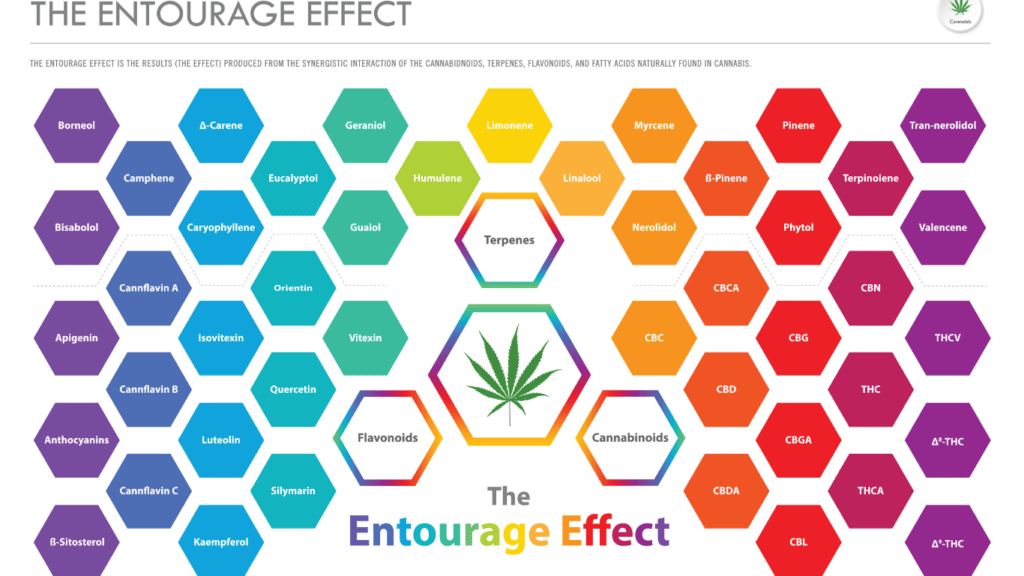
Cannabinoids, terpenes, flavonoids, and other constituents are often discussed in entourage-effect research. Their presence in the same extract does not, by itself, prove beneficial synergy.
Quick Answer: What Does the Entourage Effect Mean?
The entourage effect refers to the idea that hemp compounds may work together rather than acting in isolation. In full-spectrum CBD, this may include CBD, minor cannabinoids, terpenes, flavonoids, and trace THC within legal limits.
About This Guide
What Is the Entourage Effect?
The entourage effect is a hypothesis about interactions among multiple compounds found in hemp and cannabis. Instead of looking only at CBD or THC, researchers ask whether cannabinoids, terpenes, and other plant constituents can modify one another’s pharmacology or the overall effects of a preparation.
Full-spectrum products are often discussed in this context because they contain a broader mixture than CBD isolate. That compositional difference creates the possibility of interactions, but composition alone does not demonstrate that a beneficial interaction occurred.
The useful scientific question is therefore not simply whether several compounds are present, but whether a specific combination produces a reproducible effect in an experiment or controlled human study.
Cannabinoids
Learn more about cannabinoids such as CBD, CBDA, CBG, CBC, CBN, and THC.
Terpenes
Explore terpenes as aromatic plant compounds that contribute to a product’s profile.
Full-Spectrum CBD
Review what full-spectrum CBD means before comparing products.
A Simple Analogy, With Limits
A soloist-versus-orchestra analogy can help explain composition: CBD isolate contains one purified cannabinoid ingredient, while a full-spectrum extract contains a broader mixture. That analogy stops at composition.
An orchestra sounds different because the musicians are known to interact. A hemp extract does not automatically demonstrate beneficial synergy just because several compounds are present. The interaction itself still has to be tested.
Cannabinoids, Terpenes, and Flavonoids: The Compounds Behind the Concept
Entourage-effect research commonly examines cannabinoids, terpenes, and other plant constituents. Each group can have biological activity of its own, but the presence of several groups in one extract does not prove that they act synergistically.
| Compound group | What it is | Why it matters for CBD shoppers |
|---|---|---|
| Cannabinoids | Plant compounds such as CBD, CBDA, CBG, CBC, CBN, and THC. | They help define the cannabinoid profile of a hemp extract. A COA should show which cannabinoids are present and in what amounts. |
| Terpenes | Aromatic compounds found in hemp and many other plants. | They contribute aroma and may influence the product’s overall plant profile. Terpene research is still developing. |
| Flavonoids | Plant compounds found in many fruits, vegetables, herbs, and hemp. | They are part of the broader plant profile, but CBD brands should avoid overstating their health effects. |
| Other plant compounds | Natural compounds that may remain in less-refined hemp extracts. | They may contribute to the overall extract profile, depending on sourcing and extraction. |
What Researchers Have Studied
The evidence is easier to understand when proposed mechanisms, experimental findings, and unanswered clinical questions are kept separate.
A. Proposed mechanisms
Foundational papers by McPartland and Russo and a later review by Russo proposed that cannabinoids, terpenes, and other cannabis constituents could modify one another through pharmacodynamic or pharmacokinetic interactions. These papers helped define the modern entourage-effect hypothesis, but they are reviews and scientific frameworks, not randomized head-to-head trials showing that commercial full-spectrum CBD is clinically superior to purified CBD.
McPartland & Russo: Cannabis and Cannabis Extracts: Greater Than the Sum of Their Parts? | Russo: Taming THC
B. Research findings
Animal study: CBD-rich extract vs. purified CBD
Gallily and colleagues reported a different dose-response pattern for a CBD-rich extract compared with purified CBD in mouse models of inflammation and pain. This is preclinical evidence from a specific extract and does not establish human clinical superiority.
Observational human data: refractory epilepsy
A 2018 meta-analysis of observational studies found more reports of improvement and lower average CBD-equivalent doses in groups using CBD-rich extracts. However, the groups did not differ on the more rigorous threshold of at least 50% seizure reduction, the underlying studies were heterogeneous, and the authors said controlled studies were needed to confirm whether other plant compounds explained the differences.
Controlled human study: THC plus d-limonene
In a 2024 double-blind crossover study in healthy adults who intermittently used cannabis, vaporized d-limonene reduced some THC-induced anxiety and paranoia ratings. This is direct evidence that one cannabis terpene can modify some acute THC effects under specific experimental conditions. It is not a trial of full-spectrum CBD oil.
Laboratory counterexample: cannabinoid receptors
A 2020 in-vitro study found that five common cannabis terpenes did not meaningfully alter THC, CBD, or 2-AG signaling at CB1 or CB2 receptors under the tested conditions. That does not rule out every possible interaction, but it shows that proposed entourage mechanisms do not always appear when directly tested.
C. What remains unproven
- That a stable, predictable entourage effect occurs across commercial full-spectrum CBD products.
- That adding more cannabinoids or terpenes automatically produces a better outcome.
- That full-spectrum CBD is inherently safer, better absorbed, or clinically superior to CBD isolate for every person or condition.
- That results from THC-containing medicines, vaporized cannabis, or a specific experimental extract apply to retail hemp CBD oils.
Recent reviews conclude that the evidence remains mixed and product-specific, with limited controlled human data. Read the 2024 critical scoping review. Read the 2024 comprehensive review.
Full-Spectrum CBD vs Broad-Spectrum CBD vs CBD Isolate
The full spectrum vs isolate entourage effect conversation usually begins with product type. Each type has a different compound profile.
| CBD type | Composition | What the category does not establish |
|---|---|---|
| CBD isolate | Highly purified cannabidiol as the cannabinoid ingredient, without the broader cannabinoid-and-terpene mixture discussed in the whole-extract entourage hypothesis. | Isolate does not mean synthetic, and the absence of other cannabinoids does not mean CBD is biologically inactive or ineffective. |
| Broad-spectrum CBD | CBD plus some other hemp constituents, typically processed to remove or reduce THC. The exact profile varies by product. | The category name does not prove which minor cannabinoids or terpenes are present, or that a meaningful entourage interaction occurs. |
| Full-spectrum CBD | CBD within a broader hemp-extract profile that may include minor cannabinoids, terpenes, flavonoids, and measurable THC within applicable hemp limits. | A broader composition does not automatically prove superior absorption, greater safety, or better clinical outcomes. |
For a detailed composition comparison, see Full-Spectrum CBD vs. CBD Isolate: What’s the Difference?.
What a Certificate of Analysis Can Tell You
A Certificate of Analysis, or COA, can document the chemistry that a laboratory measured in a specific sample. It is useful for checking product identity and composition, but it is not a test for the entourage effect.
What a COA can help verify
- CBD and THC results for the cannabinoids included in the panel.
- Other cannabinoids that the laboratory actually tested and quantified.
- The product or batch identity shown on the report.
- Contaminant panels when pesticides, heavy metals, residual solvents, microbials, or other tests were actually performed.
What a COA cannot prove
- That the measured compounds interact beneficially in a person.
- That a product is clinically more effective than isolate or another formulation.
- That compounds not included in the test panel are present or absent.
- That a cannabinoid profile produces a particular therapeutic outcome.
What We Can Speak to From Firsthand Hemp Experience
Bill Polyniak and Kentucky Cannabis Company have worked directly with hemp cultivation, genetics, extraction, formulation, manufacturing, and laboratory-testing workflows since Kentucky’s modern hemp pilot era. That experience is useful for understanding how a full-spectrum product is made and verified. It is not clinical proof of an entourage effect.
Starting material matters
Genetics, flower quality, harvest decisions, and storage influence the plant material that enters extraction. Those are manufacturing variables, not evidence of a health outcome.
Processing changes the finished profile
Extraction, refinement, carrier selection, and formulation choices can change which compounds remain in a finished product and at what measured concentrations.
Testing verifies chemistry, not synergy
Batch testing can document cannabinoid potency, THC, and other tested quality markers. A laboratory report can confirm composition for the analytes tested, but it cannot establish that the combination produces a therapeutic entourage effect.
Genesis Blend is one example of how Bluegrass Hemp Oil applies a full-spectrum formulation and batch-documentation approach. The product is presented here as manufacturing context, not as clinical evidence. View Genesis Blend product information.
How to Choose a Full-Spectrum CBD Product Responsibly
If you are interested in the entourage effect, start with product verification rather than marketing claims. The phrase “benefits of whole plant hemp extract” should lead to better questions, not unsupported promises.
CBD Safety Considerations
CBD is not risk-free. The FDA has noted safety concerns with CBD, including possible medication interactions. Full-spectrum CBD may also contain trace THC, which may carry drug-test risk.
Explore Related CBD Guides
Learn how CBD extract types differ, what affects absorption, and how to interpret a product’s laboratory report.
Types of CBD
Compare full-spectrum, broad-spectrum, and CBD isolate by composition.
Read Types of CBDFull-Spectrum CBD vs. CBD Isolate
See how whole-extract composition differs from purified CBD without assuming one is clinically superior.
Compare Full-Spectrum and IsolateCBD Absorption
Learn how formulation, route, food, and other factors can affect CBD exposure.
Read About CBD AbsorptionCBD Lab Testing
Understand what common laboratory panels can and cannot establish.
Read the CBD Lab Testing GuideCertificates of Analysis
Review how batch-specific reports document measured product chemistry.
View Certificates of AnalysisFrequently Asked Questions About the Entourage Effect
What is the entourage effect?
The entourage effect is a proposed concept that describes how cannabinoids, terpenes, flavonoids, and other hemp compounds may work together to influence the overall profile of a hemp extract. Research is still developing, so it should not be treated as a guaranteed medical outcome.
Is the entourage effect proven?
Researchers continue to study the entourage effect. Some reviews discuss possible interactions among cannabis compounds, while others caution that the evidence is mixed, product-specific, and should not be overstated.
What does full-spectrum CBD have to do with the entourage effect?
Full-spectrum CBD contains CBD along with other naturally occurring hemp compounds, such as minor cannabinoids, terpenes, flavonoids, and trace THC within legal limits. This broader plant profile is why full-spectrum CBD is often discussed in relation to the entourage effect.
Is full-spectrum CBD better than CBD isolate?
Not automatically. Full-spectrum CBD contains a broader mixture, while CBD isolate is purified cannabidiol. The broader composition makes compound interactions possible, but it does not prove superior absorption, safety, or clinical outcomes.
Does CBD need THC to work?
CBD does not need THC to be CBD. Trace THC is one supporting compound in many full-spectrum hemp extracts, and it may be part of the broader plant profile. It is not included to create intoxication, and full-spectrum products should always be reviewed with a certificate of analysis.
Do terpenes matter in CBD oil?
Terpenes contribute aroma and may be part of the overall hemp extract profile. The role of terpenes in CBD oil is still being studied, so brands should avoid making guaranteed health claims based on terpenes.
What is the CBD and CBG entourage effect?
CBD and CBG are two cannabinoids that may appear together in a full-spectrum cannabinoid profile. Researchers continue to study how cannabinoids may interact, but shoppers should use lab results to verify what is actually present in a product.
Can full-spectrum CBD make me high?
CBD itself is not intoxicating. However, full-spectrum CBD may contain trace THC within legal hemp limits. Review the certificate of analysis before using any full-spectrum product.
Can full-spectrum CBD show up on a drug test?
Full-spectrum CBD may contain trace THC, and THC exposure may carry drug-test risk. Anyone subject to workplace, legal, athletic, or medical drug testing should review lab results carefully and consider avoiding THC-containing products.
How do I know if a CBD product is truly full-spectrum?
Start with the product label and a batch-specific COA. A cannabinoid panel can show which tested cannabinoids were measured, including CBD and THC where present. Terpenes require terpene testing. None of these reports, by themselves, proves a therapeutic entourage effect.
Does the entourage effect mean CBD treats medical conditions?
No. The entourage effect should not be used to claim that CBD treats, cures, prevents, or diagnoses disease. CBD products should be evaluated for quality, safety, labeling, and lab testing.
Use the Evidence and the Product Information Together
The entourage effect is a useful research question, not a shortcut for proving that a product will work better. When comparing CBD products, separate the scientific evidence from the product’s measured composition, ingredients, THC content, and batch documentation.
FDA Disclaimer
These statements have not been evaluated by the Food and Drug Administration. Bluegrass Hemp Oil products are not intended to diagnose, treat, cure, or prevent any disease. This content is for general education only and is not medical advice. Consult a qualified healthcare professional before using CBD if you are pregnant, nursing, taking medications, managing a medical condition, or subject to drug testing. Keep all cannabinoid products out of reach of children and pets.
Sources and Further Reading
- McPartland JM, Russo EB. Cannabis and Cannabis Extracts: Greater Than the Sum of Their Parts? Journal of Cannabis Therapeutics. 2001. Foundational review proposing botanical synergy.
- Russo EB. Taming THC: Potential Cannabis Synergy and Phytocannabinoid-Terpenoid Entourage Effects. British Journal of Pharmacology. 2011. Review and hypothesis framework.
- Gallily R, Yekhtin Z, Hanuš LO. Overcoming the Bell-Shaped Dose-Response of Cannabidiol by Using Cannabis Extract Enriched in Cannabidiol. 2015. Mouse study comparing a CBD-rich extract with purified CBD.
- Pamplona FA, da Silva LR, Coan AC. Potential Clinical Benefits of CBD-Rich Cannabis Extracts Over Purified CBD in Treatment-Resistant Epilepsy. Frontiers in Neurology. 2018. Meta-analysis of observational human data.
- LaVigne JE, et al. Terpenoids From Cannabis Do Not Mediate an Entourage Effect by Acting at Cannabinoid Receptors. 2020. In-vitro receptor study providing counterevidence for one proposed mechanism.
- Spindle TR, et al. Vaporized D-limonene Selectively Mitigates the Acute Anxiogenic Effects of Δ9-THC in Healthy Adults. 2024. Controlled human study of a specific terpene-THC interaction.
- Simei JLQ, et al. Does the “Entourage Effect” in Cannabinoids Exist? A Narrative Scoping Review. 2024. Critical review of clinical and mechanistic evidence.
- U.S. Food and Drug Administration: CBD safety information.